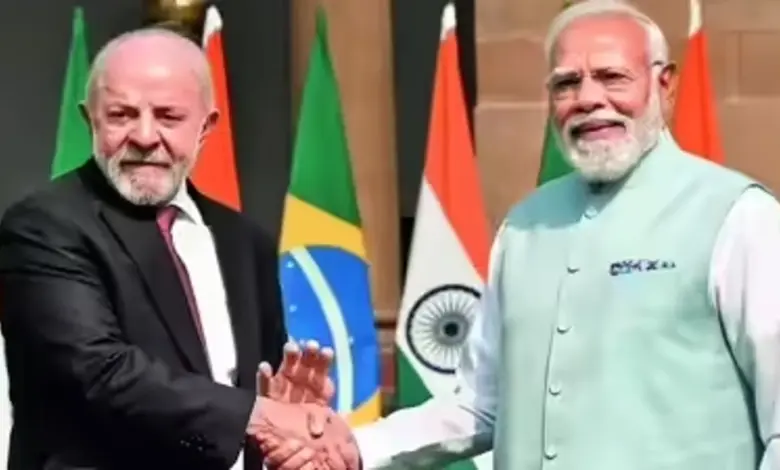
In a significant move to diversify global supply chains for strategic resources, India and Brazil signed a memorandum of understanding (MoU) on cooperation in rare earth elements and critical minerals. The agreement was formalized during talks in New Delhi on Saturday between Prime Minister Narendra Modi and Brazilian President Luiz Inácio Lula da Silva at Hyderabad House.
The pact comes as India seeks to lessen its heavy dependence on China, which supplies nearly 90 per cent of the country’s imports of these essential materials used in electronics, renewable energy technologies, and defence applications.
A joint statement released after the meeting welcomed the MoU, expressing hope that it would enhance bilateral collaboration and bolster supply value chains. The leaders emphasized strengthening global competitiveness in areas including mineral exploration, mining, processing, recycling, and refining of critical minerals.
During a media briefing, Secretary (East) in the Ministry of External Affairs, P. Kumaran, highlighted Brazil’s vast untapped potential in this sector. He noted that President Lula presented details on the country’s substantial reserves of critical minerals and rare earths, with only about 30 per cent currently explored. This leaves considerable room for further exploration, processing, and value addition.
Kumaran quoted Lula as stating that Brazil highly values India’s partnership in critical minerals and that India would explore avenues to advance this cooperation.
The discussions also touched on broader energy transition goals. Both leaders recognized the importance of sustainable biofuels, sustainable aviation fuel, solar, wind, hydroelectric, and nuclear sources in achieving climate objectives and advancing clean energy shifts.
On the economic front, the two countries committed to surpassing their earlier bilateral trade target of $20 billion by 2030—originally set during Modi’s visit to Brasilia in July 2024—and agreed to aim for at least $30 billion by that year. Current bilateral trade stands at approximately $15.21 billion, with India maintaining a surplus of about $1.5 billion (exports around $6.7 billion, imports around $5.4 billion). India ranks as Brazil’s largest trading partner in South America.
ALSO READ : Modi And Lula Set $20 Billion Trade Target, Vow Stronger India–Brazil Ties On Global Stage
The leaders expressed intent to diversify and expand trade through enhancements to the India-Mercosur Preferential Trade Agreement (PTA). Mercosur includes Brazil, Argentina, Uruguay, Paraguay, and Bolivia. The existing PTA covers 450 tariff lines, and both sides have agreed to significantly broaden its scope, with ongoing discussions addressing sensitivities in agriculture and certain industries while prioritizing national interests and supply chain resilience.
This agreement on rare earths and critical minerals marks a key step in building more secure and diversified global supply networks amid increasing geopolitical and economic uncertainties.
-
-

-

-