
China’s $100 Billion In Loans At Stake In Venezuela After US Captures Maduro
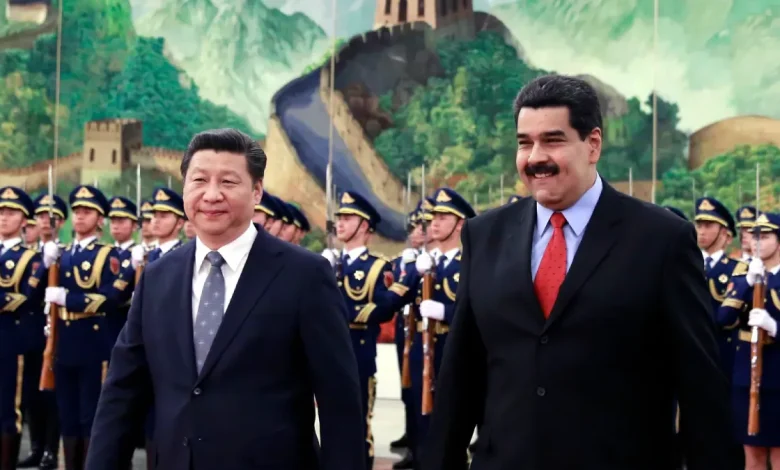
China issued a sharp rebuke following the US military’s “Operation Absolute Resolve” that resulted in the capture of Venezuelan President Nicolas Maduro and his wife Cilia Flores from Caracas. Beijing condemned the action, stating that such “hegemonic acts of the US seriously violate international law and Venezuela’s sovereignty,” and urged Washington to “abide by international law and the purposes and principles of the UN Charter, and stop violating other countries’ sovereignty and security,” according to a Chinese foreign ministry statement.
Just hours before the US strikes, China’s Special Representative on Latin American Affairs, Qiu Xiaoqi, met with President Maduro, underscoring Caracas’s strategic importance to Beijing’s Latin American engagement a relationship backed by approximately $105.6 billion in loans and financial assistance.
China’s strategic gamble
Venezuela has occupied a pivotal position in China’s efforts to project influence beyond Asia. The formal relationship began in 2006 under President Hugo Chávez, when Caracas inked multiple trade deals with Beijing while characterizing China as a “Great Wall” shielding against US dominance.
These agreements obligated Venezuela to deliver up to one million barrels of daily oil shipments to China. Beijing, in exchange, pledged diplomatic support, including backing Venezuela’s campaign for a non-permanent UN Security Council seat, media reports indicate. By 2008, China was obtaining nearly half its oil imports from Venezuela, establishing the South American nation as vital to Chinese energy security.


The financial pipeline
The partnership evolved into a major financial arrangement, with China extending substantial loans secured by future oil deliveries. Beijing provided $2 billion in 2006, escalating to $7 billion in 2007, according to US-based research organization AidData. Lending accelerated dramatically afterward—$8 billion in 2009 and approximately $27 billion in 2010.
In 2007, both nations established a $6 billion joint fund comprising a $4 billion China Development Bank loan and $2 billion from Venezuela’s state development fund, FONDEN. Oil shipments from PDVSA, Venezuela’s state petroleum company, guaranteed repayment. The fund doubled to $12 billion in 2009 through additional contributions from both governments.
China maintained lending even as Venezuela’s economy deteriorated. In 2014, it authorized a $1 billion credit facility for PDVSA plus another $1.5 billion loan for operational capital.
When international oil prices crashed in 2014 and Venezuela’s economy collapsed under President Nicolás Maduro, China extended an additional $10 billion balance-of-payments loan, again collateralized by oil exports. In 2015, Beijing restructured approximately $50 billion in outstanding debt, reducing daily oil delivery requirements and permitting partial repayments in local currency.
Read More: Venezuelan Opposition Veteran Slams Trump’s Post-Capture Vision as ‘Bizarre’
Since 2016, China has essentially halted fresh lending to Venezuela, concentrating instead on reorganizing existing obligations. Despite this pause, Venezuela ranks among China’s largest debtors, meaning any political transition in Caracas could trigger substantial financial repercussions for Beijing.