
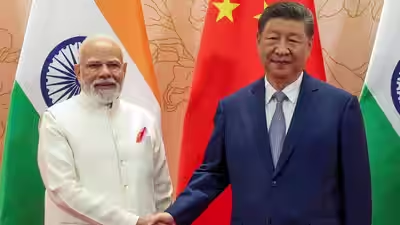
Chinese President Xi Jinping is scheduled to visit India for the first time in seven years, attending the BRICS summit in New Delhi on September 12-13 at the invitation of Prime Minister Narendra Modi. A bilateral meeting between the two leaders is planned for Saturday evening.
Xi will travel with a 67-member government delegation that includes senior official Cai Qi and Foreign Minister Wang Yi. A separate business delegation is also expected. The visit will last exactly 24 hours, with arrival planned for around midday on Saturday and departure the following day.
Upon arrival, Xi is expected to reach Bharat Mandapam in the afternoon, where he and other leaders will be welcomed by Modi. The bilateral discussion is likely to occur between a closed BRICS session on multilateralism and a dinner hosted by Modi later that evening.
The visit is seen as continuing the positive momentum in bilateral relations that began after the leaders met on the sidelines of the 2024 BRICS summit in Kazan. That meeting marked progress toward complete disengagement and resolution of issues stemming from the 2020 eastern Ladakh military standoff.




During the upcoming talks, India is expected to raise concerns about fair market access, supply chain reliability and the balance of bilateral trade as both sides explore ways to expand economic cooperation. The leaders had earlier agreed in Kazan to restart high-level engagements and directed Special Representatives on the boundary question to manage peace and tranquility along the border while seeking a fair and mutually acceptable solution.
Since then, the Special Representatives have held three rounds of boundary talks. The most recent meeting in August produced eight outcomes, including steps toward finalising terms for early progress on boundary delimitation and border management.
China is set to assume the BRICS presidency next year after India’s current chairship. The short visit is expected to further support the recent thaw in relations, with both sides previously describing themselves as partners rather than rivals.