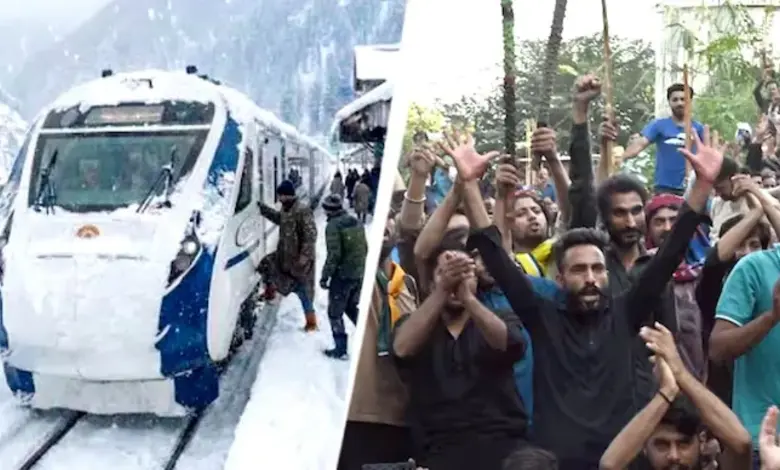
Srinagar: High in the rugged mountains near Zojila Pass, where the winds carry far more than the chill of the Himalayas, the story of Kashmir continues to unfold in two very different ways. Separated by the Line of Control (LoC), the region remains a land of contrasting realities, competing narratives and generations of uncertainty.
The divide was on display once again as emotions ran high across both sides of Kashmir. While celebrations and expressions of support for opposing causes occasionally surface in pockets of the region, they also serve as a reminder of how deeply the decades old conflict continues to shape identities and loyalties. What may appear as a moment of jubilation to one side is often viewed with suspicion or concern by the other.
For India, Zojila is far more than a mountain pass. Sitting at an altitude of over 11,500 feet, it serves as the vital gateway connecting the Kashmir Valley with Ladakh. The route has immense strategic importance, allowing the movement of troops, supplies and civilians through some of the world’s most challenging terrain. The ongoing construction of the Zojila Tunnel is expected to transform connectivity in the region by providing all weather access between Kashmir and Ladakh.
Yet beyond its military and infrastructural significance, Zojila stands as a symbol of the larger Kashmir story one shaped by geography, politics and history.
More than seven decades after the first India-Pakistan war of 1947-48, Kashmir remains divided between areas administered by India and Pakistan, separated largely by the Line of Control. Despite periods of relative calm, the frontier remains one of the most heavily militarised boundaries in the world.
On the Indian side, major investments in roads, tunnels, tourism and public infrastructure have altered the landscape in recent years. The government has repeatedly highlighted development projects as evidence of growing stability and economic opportunity. Tourist arrivals have surged in many parts of the Valley, and authorities continue to push for greater integration and investment.
Across the LoC, however, the political discourse remains centred on the unresolved status of Kashmir and the aspirations of its people. Pakistan continues to raise the issue at international forums, while residents in Pakistan administered Kashmir face their own economic and governance challenges.
For ordinary Kashmiris, life is often defined less by geopolitics and more by everyday concerns. Farmers worry about harvests, traders about business, students about opportunities and families about the future. Yet the conflict is never far away. The LoC has witnessed periods of ceasefire violations over the years, forcing residents in border villages to live with the constant possibility of disruption.
The ceasefire understanding reaffirmed by India and Pakistan in February 2021 significantly reduced cross border firing in many sectors, bringing relief to thousands of people living near the frontier. While the arrangement has largely held compared to previous years, mistrust between the two nuclear-armed neighbours continues to run deep.
That is perhaps what makes Kashmir’s story so complex. It is a place where breathtaking natural beauty coexists with political tension; where aspirations for peace often compete with historical grievances; and where a line drawn on a map continues to influence the lives of millions.
Standing near Zojila, one can see mountains stretching endlessly into the distance. But beyond those peaks lies a region divided not just by a boundary, but by competing memories, hopes and visions for the future. And until those differences find a path toward reconciliation, the tale of two Kashmirs will remain one of South Asia’s most enduring and emotional stories.
ALSO READ: POK Protests Reach UK As 30 British MPs Raise Human Rights Concerns Over Crackdown