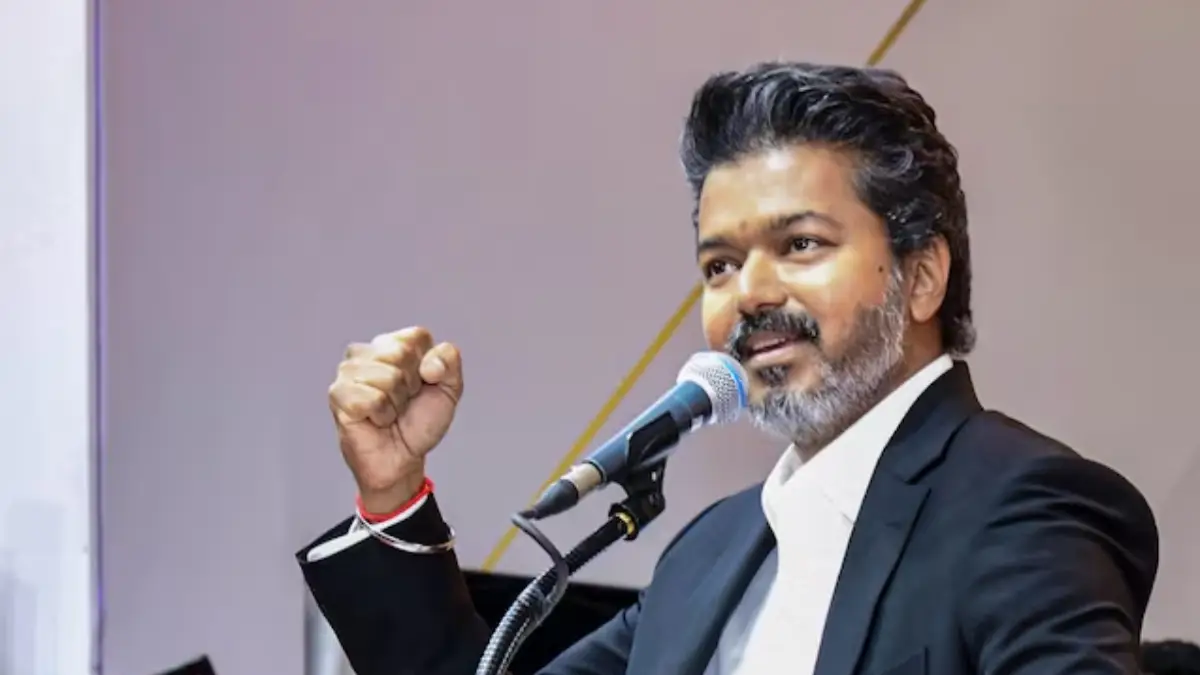
Chennai : In Tamil cinema, the hero’s introduction scene is sacrosanct: thunderous, inevitable, larger than life. When C Joseph Vijay was sworn in as Tamil Nadu’s ninth Chief Minister on May 10, the real-world version was no different. The actor-turned-politician had toppled the Dravidian duopoly that had governed the state virtually without interruption since 1967, riding a mandate that would have looked implausible in a script.
The Chief Minister arrives at the Secretariat precisely on time, his sharply tailored black suit and white shirt, a deliberate departure from the white veshti of Tamil political tradition, making a quiet statement before he has said a word. Vijay spends a full seven hours at his desk from Monday to Friday, has made administrative punctuality a non-negotiable for officials reporting to him, and reportedly brings his own lunch, eating quietly in his cabin.
The move, involving 276 outlets near religious sites, 186 near schools and colleges, and 255 near bus terminals, fulfilled a central TVK manifesto commitment and was completed within the stipulated fortnight. It directly affected 3,474 employees, though the government moved quickly to redeploy most to other TASMAC locations. On women’s safety, Vijay has moved from announcement to deployment. The Singapenne (Lioness) Special Task Force, formally launched on June 9, is a dedicated police unit focused on crimes against women and children, headed by senior IPS officer K. Bhavaneeswari. Personnel are now being deployed across all districts. Whether the unit delivers in practice what it promises in name will be the real test.
Contractors’ Association President Gunamani publicly acknowledged that the new government had instructed contractors not to pay bribes to ministers or government officials, and went a step further, alleging that the previous administration had routinely extracted a 15 per cent commission on contract approvals. Whether this directive translates into structural change, or remains a statement of intent, will depend on sustained follow-through.
The document provides a framework for measurable accountability, though its sheer breadth invites the familiar risk of over-promising. Accompanying it is a clear anti-corruption mandate: the Chief Minister has explicitly warned that corrupt officials will face swift penalties regardless of their proximity to the party leadership. In his first address as Chief Minister, he also pledged to eliminate parallel power centres – the informal intermediaries who have historically extracted operational bribes from contractors and citizens – in favour of a single-window clearance system.
Read Also : Zojila Tunnel Breakthrough Brings Ladakh Closer to Year-Round Connectivity
-
-
-
-