
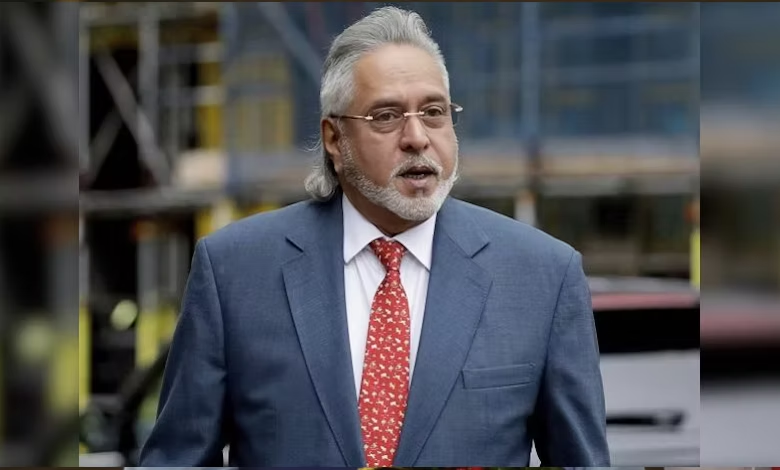
Mumbai: The long running legal battle between businessman Vijay Mallya and a consortium of banks over the recovery of assets linked to the collapse of Kingfisher Airlines may finally be nearing its end. The Bombay High Court has asked the Enforcement Directorate (ED) to provide an update on its investigation and the status of assets attached in the case, while stressing that the nearly decade old commercial dispute should reach a “logical conclusion.”
A single judge bench headed by Justice Milind Jadhav was hearing Mallya’s 2020 petition challenging an order of the special Prevention of Money Laundering Act (PMLA) court. That order had permitted the State Bank of India led consortium of banks to utilise assets attached by the ED for recovery of dues connected with Kingfisher Airlines.
The latest proceedings do not amount to a clean chit for Mallya. The court’s focus is primarily on the commercial and asset recovery dispute. Justice Jadhav indicated that the parties should look towards a practical resolution rather than allowing the matter to remain locked in litigation indefinitely. The court also observed that prolonging such disputes could have a direct and negative impact on the economy.
Mallya, now 70, left India for the United Kingdom in March 2016 as banks pursued recovery proceedings over loans extended to the now defunct airline. The debt has commonly been described as around Rs 9,000 crore. In January 2019, he was declared a “fugitive economic offender”, a status created under the Fugitive Economic Offenders Act, 2018 to enable action against individuals who leave India to evade prosecution, including attachment and confiscation of property.



The asset recovery numbers have themselves become a point of contention. In 2024, Mallya claimed that Rs 14,131.6 crore worth of his assets had been recovered by the ED and banks, arguing that the amount exceeded the debt determined by the Debt Recovery Tribunal. The figure was also cited by the Finance Minister in Parliament in connection with assets returned to public sector banks. Mallya has continued to dispute aspects of the recovery process.
His wider legal troubles remain unresolved. In February 2026, the Bombay High Court refused to entertain his challenge to his fugitive economic offender designation unless he returned to India and submitted to the court’s jurisdiction. Mallya subsequently said he could not specify when he would return, citing legal restrictions in the UK.
His extradition to India also remains pending. His final UK appeal against extradition was rejected in 2020, but the extradition order has not been enforced because other legal issues remain unresolved.
For now, the Bombay High Court’s latest intervention is significant because it signals that the focus is shifting from another round of prolonged litigation to determining what remains of the asset dispute and how it can finally be brought to an end.
ALSO READ: ‘First Return To India, Then We’ll Hear Your Case’: Bombay HC’s Tough Message To Vijay Mallya