
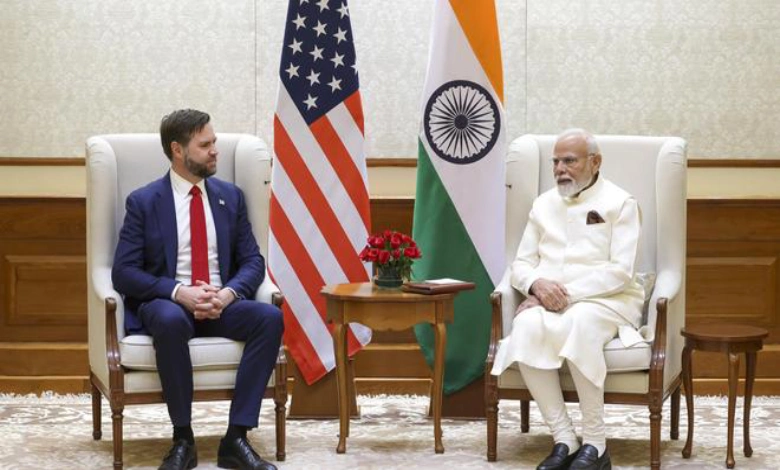
In light of growing tensions in West Asia, U.S. Vice-President J.D. Vance called Prime Minister Narendra Modi on Saturday, August 8, 2026, to discuss strengthening India-U.S. comprehensive global strategic connections in commerce, defense, and energy security.
Additionally, the two leaders reiterated their dedication to enhancing cooperation in essential minerals and emerging technologies.
Days after Turkiye, Saudi Arabia, and Pakistan signed a mutual defense agreement that was generally interpreted as a sign of a new regional alignment during the West Asia crisis, Mr. Vance called the prime minister.
PM Modi congratulated Mr. Vance and Second Lady Usha on the birth of their son during the conversation.


JD Vance, the vise president of the United States, called me. On social media, Mr. Modi stated, “We talked about ways to further deepen India-US Comprehensive Global Strategic Partnership across key areas.”
“Warmly congratulated him and the Second Lady on the birth of their son and sent best wishes to the entire family,” he stated.
According to an Indian readout, PM Modi and VP Vance discussed the state of the comprehensive global strategic alliance between the United States and India. It stated, “They reaffirmed their commitment to further strengthening cooperation in trade, defense, critical and emerging technologies, energy security, and critical minerals and noted the sustained momentum in the high-level engagements.” It further stated that “they also exchanged views on regional and global developments of mutual interest.”
Details of the conversation have not yet been released by the American side.
Whether the proposed trade agreement between the United States and India was a factor in the negotiations is not immediately clear.
During their June meeting in France, U.S. President Donald Trump and Prime Minister Modi gave their officials instructions to strive for a fair, mutually advantageous, and commercially significant trade agreement as soon as possible.
After Washington slapped punishing tariffs on India last year and Mr. Trump made claims about his role in defusing the May 2025 military skirmishes between India and Pakistan, which caused Indian leaders to respond sharply, the relations saw a significant decline.
The U.S. president openly and again asserted throughout the course of the following few months that he had prevented a full-scale warfare between the two neighbors and spared millions of lives.
New Delhi insisted that the United States had nothing to do with the end of hostilities and that it was the outcome of negotiations between India and Pakistan.
The decline in India-US relations was also influenced by Washington’s new immigration policy and its decision to raise the H1B visa price. But in recent months, both parties have worked to mend fences and have even taken steps to shortly solidify the trade agreement.
Also Read – Iran Tells US It Won’t Charge Ships Using Strait of Hormuz, Says JD Vance