
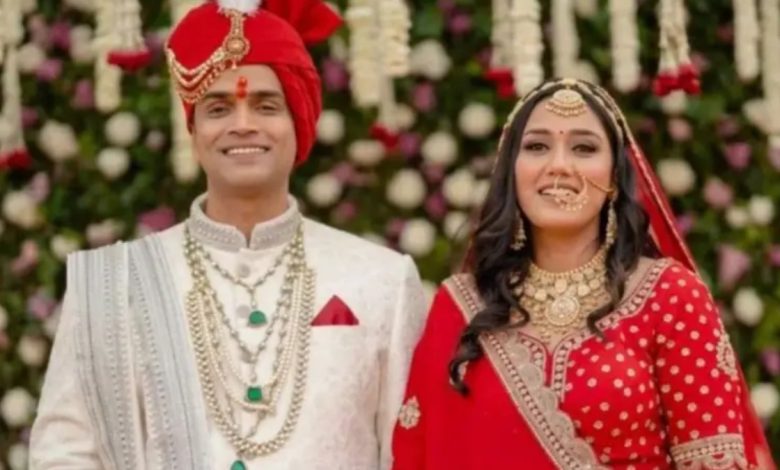
Samarth Singh, husband of 33-year-old Twisha Sharma who was found hanged at their residence in Bhopal’s Katara Hills area, surrendered before the Jabalpur Court on Friday after remaining on the run for 10 days. His lawyer conveyed to the court that Singh was ready to surrender, and the High Court allowed him to do so before the trial court or at Katara Police Station in Bhopal, deferring the matter to the next hearing on Monday.
“He will surrender immediately. He has to prepare for his wife’s last rites,” his counsel said. Singh also informed the court through his lawyer that he would withdraw his anticipatory bail plea.
Twisha’s family, from Noida, has accused her husband and in-laws of dowry harassment and alleged that she was driven to take her own life. The in-laws have denied the allegations, claiming Twisha suffered from drug addiction and psychiatric issues.
The preliminary autopsy report from AIIMS Bhopal indicated death by hanging. Twisha’s family has disputed the findings and sought a second post-mortem. The court has agreed to the request. However, lawyer for Twisha’s mother-in-law Giribala Singh opposed the second autopsy, arguing that conducting one would reflect poorly on the medical fraternity. “It reflects their own incompetence and shows they do not trust their own doctors,” the lawyer said.




Solicitor General Tushar Mehta, while partly agreeing with that argument, said a second autopsy could be conducted if the family believed investigators had overlooked something in the first examination.
Singh’s lawyer also raised concerns about potential decomposition of Twisha’s body, arguing that last rites should not be further delayed. “She was the daughter-in-law of our family. It is our duty to perform her last rites,” the lawyer said. The court noted that preserving the body for an extended period requires storage at -80 degrees Celsius, while the body is currently being held at -4 degrees Celsius in the AIIMS Bhopal mortuary. A -80 degree facility is not available in the city.
The Madhya Pradesh government has recommended transferring the case to the Central Bureau of Investigation and has given its formal consent for the transition. The consent, signed by Home Department Secretary Krishnaveni Deshavatu, has been communicated to central and state authorities to initiate the immediate transfer of case files.