
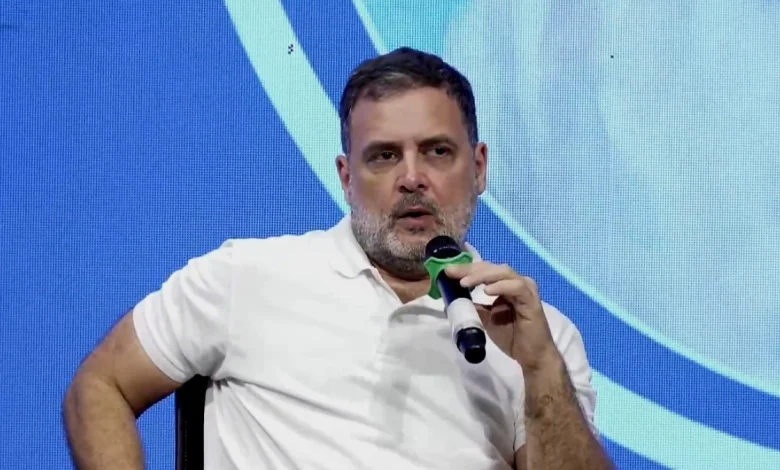
“There are no jobs, and we are heading into a storm.” With this warning, Leader of the Opposition Rahul Gandhi shifted the focus of the ongoing political debate from examination paper leaks to what he described as India’s looming employment crisis.
Addressing a press conference following the Opposition’s protest over the alleged NEET paper leak and the July 20 clashes near Parliament, Gandhi argued that while paper leaks have damaged the education system, the country is heading towards a far bigger challenge: the lack of jobs for millions of young Indians.
“There is a fundamental issue regarding jobs that is causing tremendous pain, and I have already stated that we are heading into a storm,” Gandhi said.




He linked the education crisis to shrinking employment opportunities, claiming that manufacturing has weakened, entrepreneurship remains out of reach due to limited access to credit, corporate hiring is slowing because of Artificial Intelligence (AI), and public sector opportunities are shrinking amid privatisation.
The Changing World of Work
According to the Leader of the Opposition, government jobs have become the only avenue left for many young Indians, even as recruitment examinations continue to face allegations of leaks and irregularities.
The data paints a difficult picture of the employment landscape. Around 51–53% of people aged 15 years and above were employed during the first half of 2026, according to World Population Review, which recorded the figure at 52.6% in March, 52.2% in April, and 51.4% in May 2026.
Gandhi also backed the demands of protesting students, calling for accountability over the alleged paper leaks, action against those responsible for violence during the protests, and the resignation of Union Education Minister Dharmendra Pradhan. He alleged that repeated examination leaks had eroded trust in the education system, leaving students and their families disillusioned.
His remarks come at a time when the global economy is facing heightened uncertainty. As the State of Working India Report 2026 by Azim Premji University notes, “Never before have so many young Indians been as educated and as connected.”
The government’s PLFS 2025 data shows that nearly 40% of graduates aged 15-25 are unemployed, while around 20% of those aged 25-29 remain without jobs. India has also revised its growth projections amid global headwinds, even as private sector hiring stays uneven.
The World Bank has committed around $830 million to modernise India’s Industrial Training Institutes (ITIs), acknowledging that nearly 12 million people enter the country’s labour force every year.
Also Read:Cockroach Janta Party’s Instagram Account Take Down in India; Here’s Why
At the same time, employers are increasingly prioritising practical skills over conventional degrees. A recent Indeed survey found that 40% of employers now value AI skills and professional certifications more than traditional degrees, pointing to a broader shift towards skill-first hiring. Demand is rising for expertise in AI, cloud computing, cybersecurity and data analytics, as companies increasingly seek candidates who can demonstrate practical capabilities rather than academic qualifications alone.
While the political battle over paper leaks is likely to continue, Gandhi’s remarks have widened the debate beyond examinations. His warning suggests that the challenge before India is no longer limited to ensuring fair recruitment, but extends to creating enough quality jobs for a rapidly growing workforce in an economy being reshaped by technology and global uncertainty.