
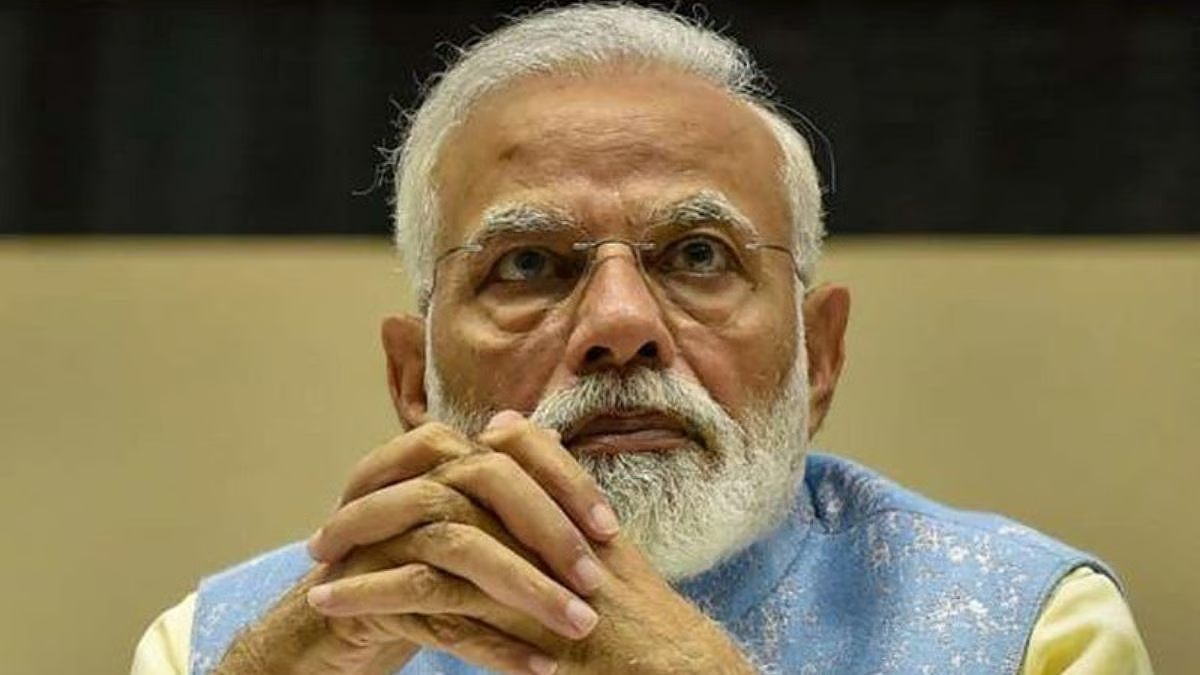
New Delhi: On Thursday, Prime Minister Narendra Modi characterized the 1975 Emergency as an explicit onslaught against the country’s founding document, while honoring the individuals who stood up to protect democratic ideals during that era, according to a report by the news agency ANI.
Marking the 51st anniversary of the event via a social media post on X, the Prime Minister highlighted the severe curtailment of citizen freedoms and the widespread detention of political figures under the stringent Maintenance of Internal Security Act (MISA).
The Suppression of Rights and Citizen Courage
In his statement, PM Modi extended his respects to everyone who consistently championed democratic principles during what he described as one of the bleakest phases in the nation’s history. He noted that the Emergency era was marked by a direct attack on the Constitution, featuring the halting of civil liberties, heavy regulations on free speech, and the jailing of political leaders, media professionals, and social activists. This period, he stated, represented a deep blow to the institutional frameworks that uphold Indian democracy.
Concurrently, the Prime Minister pointed out that the crisis brought to light the exceptional bravery of countless everyday citizens who rejected silence and instead fought to preserve the core values outlined in the Constitution.




Recommitting to the National Charter
The Prime Minister took the opportunity to reiterate his administration’s dedication to upholding constitutional standards. He stated that the nation’s charter reflects the collective goals, privileges, and obligations of 140 crore citizens. He further asserted a shared resolve to protect these principles, pledging that the spirit of the Constitution would continue to guide the development of an India fundamentally dedicated to fairness, freedom, equality, and brotherhood.
A Look Back at the 1975 Proclamation
The historical context of the event traces back to June 25, 1975, when the country’s then-President, Fakhruddin Ali Ahmed, officially declared a state of Emergency under Article 352, pointing to “internal disturbance” as the primary justification. This state of affairs gripped the nation from June 25, 1975, until its eventual conclusion on March 21, 1977.
The administration of the then-Prime Minister, Indira Gandhi, faced intense pushback for stripping away fundamental rights and orchestrating the imprisonment of opposition figures. Among those detained under MISA was Jayaprakash Narayan, who had previously spearheaded the influential Sampoorn Kranti Bihar Movement against the ruling Congress administration during the 1970s.
Documentation from the Shah Commission reports confirms that this era was defined by extensive state detentions, a state-enforced sterilization campaign, and strict government censorship over media outlets. Notably, the Bharatiya Janata Party (BJP) had designated the preceding 50th anniversary of the historical event as “Samvidhan Hatya Diwas.”
Also Read: For First Time, NCERT Includes Emergency In Class 9 Textbooks