
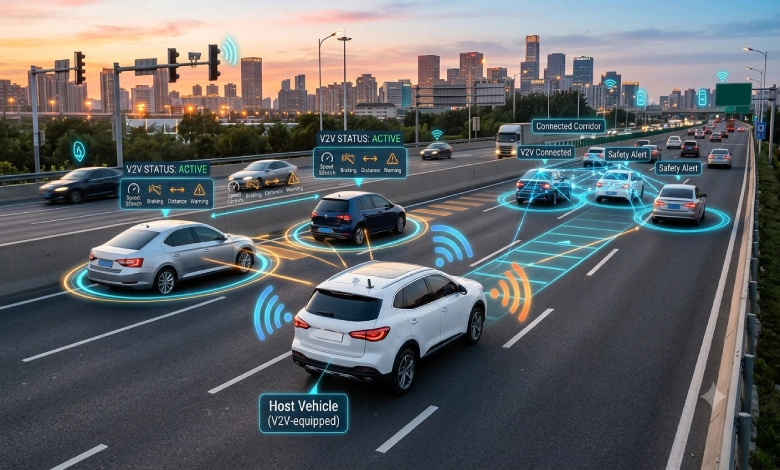
One of the first significant auto markets in the world to require Vehicle-to-Vehicle (V2V) communication technology for a variety of automobiles could be India. A draft notification from the Ministry of Road Transport and Highways (MoRTH) suggests amending the Central Motor Vehicles Rules, 1989 to allow for the gradual installation of V2V communication systems in new cars.
According to the draft notification, V2V communication devices must be installed in all newly manufactured L, M, and N category vehicles made on or after October 1, 2028. Two-wheelers and three-wheelers fall under the L category, automobiles, SUVs, and buses fall under the M category, and trucks and light commercial vehicles are under the N category.
As of October 1, 2027, cars that are already equipped with V2V technology must adhere to the specified criteria. Giving automakers and component suppliers enough time to develop and incorporate the new technology into their products is the goal of the gradual rollout.
In contrast to traditional safety systems that rely on cameras, radar, and other onboard sensors, vehicle-to-vehicle (V2V) communication allows vehicles to wirelessly exchange data with neighboring vehicles, including acceleration, speed, position, and direction. This makes it possible for cars to get alerts even when possible dangers are outside the driver’s direct line of sight or the onboard sensors’ detection range.




V2V, for instance, can warn drivers about unexpected emergency braking by cars in front of them, dangerous lane changes, an emergency vehicle approaching, or accident hazards concealed behind blind corners. Instead than taking the place of current Advanced Driver Assistance Systems (ADAS), the technology is anticipated to enhance them. According to the government, the proposed framework will boost linked mobility technologies targeted at lowering traffic accidents, enhance vehicle situational awareness, and enable quicker safety alerts.
The Department of Telecommunications has previously set aside the 5.875 GHz to 5.925 GHz frequency range for V2V communication and other Intelligent Transportation System (ITS) technologies in support of the implementation. Low-latency communication between cars will be made possible by this dedicated spectrum, which is essential for sending safety-related messages in real time.
Privacy advocates contend that if these broadcasts are gathered over time by roadside infrastructure or third parties, they may be used to reconstruct a vehicle’s travel patterns, even though the V2V communications systems are not intended to contain personal information like the driver’s name, phone number, or VIN.
Additionally, some experts suggest that insurance firms may use connected vehicle data in the future to better evaluate driving behavior or accident situations. This raises questions about data privacy and how much car information should be available to third parties, even though it may assist lower bogus claims and expedite payouts.
Also Read – India Approves Strategic 17 Km Rail Link Near China-Bhutan Border