
‘Prime Minister Ambani’: Elon Musk Escalates Starlink Row, Questions Delay In India Launch
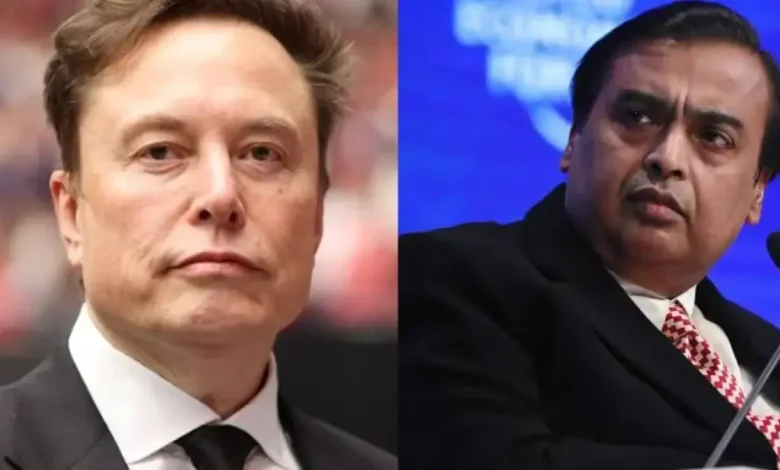
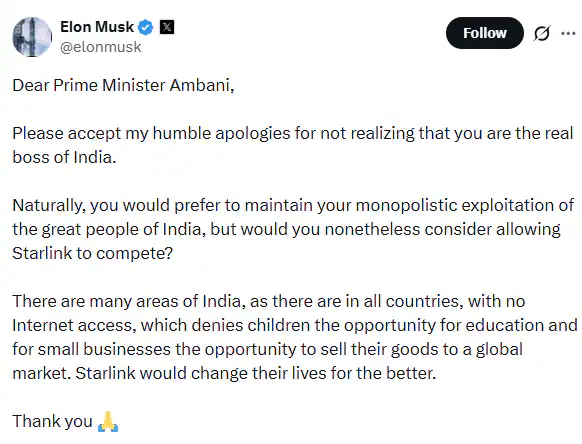
New Delhi: Elon Musk has sharpened his attack over Starlink’s delayed entry into India, taking a swipe at Reliance Industries chairman Mukesh Ambani by sarcastically calling him “Prime Minister Ambani” and accusing him of seeking to protect monopolistic interests. The remarks have reignited debate over competition in India’s telecommunications sector, even as the government maintains that satellite internet operators must fulfil security requirements before launching commercial services.
Musk’s latest comments, posted on X on October 9, followed his earlier allegations that powerful business interests were preventing Starlink from entering the Indian market. The SpaceX and Tesla chief argued that satellite internet could connect underserved communities, help children access educational resources and enable small businesses to reach customers beyond their local markets.
However, Musk’s accusations against Ambani remain unsubstantiated. No publicly established evidence has demonstrated that Reliance or its chairman is responsible for the delay in Starlink’s commercial launch.
Government rejects claims of regulatory bias



India’s Ministry of Communications has rejected allegations that the country’s regulatory framework favours particular companies. The government has maintained that satellite communication providers must satisfy applicable security requirements before being permitted to commence commercial operations.
Starlink has secured a telecommunications licence and authorisation from the Indian National Space Promotion and Authorisation Centre (IN-SPACe). These approvals, however, do not automatically permit the company to begin services, as additional regulatory and security clearances remain necessary.
The other major players in India’s satellite communications market include Eutelsat OneWeb, backed by Bharti Enterprises, and Jio Satellite Communications, part of the Reliance backed Jio Platforms. Their progress through the regulatory process is central to the wider debate over whether all operators are being treated equally.
India’s satellite internet battle gathers momentum
Starlink’s proposed entry could expand internet access in remote and geographically challenging regions where conventional broadband infrastructure remains limited. Its low Earth orbit satellite network is designed to deliver connectivity without relying entirely on terrestrial infrastructure.
At the same time, the prospect of another major player entering India’s connectivity market raises questions about competition, pricing, spectrum allocation and regulatory oversight. Reliance Jio and Bharti Airtel already occupy significant positions in the country’s telecommunications industry.
For Musk, India represents a potentially substantial market for Starlink. For the government, the challenge is to facilitate competition and improve connectivity while ensuring that security and licensing obligations are met.
The immediate question is when Starlink will receive the remaining clearances needed to launch. Until then, Musk’s public criticism is likely to keep the dispute in the spotlight, but his allegations against Ambani should not be mistaken for established evidence of interference.
ALSO READ: India Deserves Better Internet, Not Starlink Or Musk’s Gaslighting