
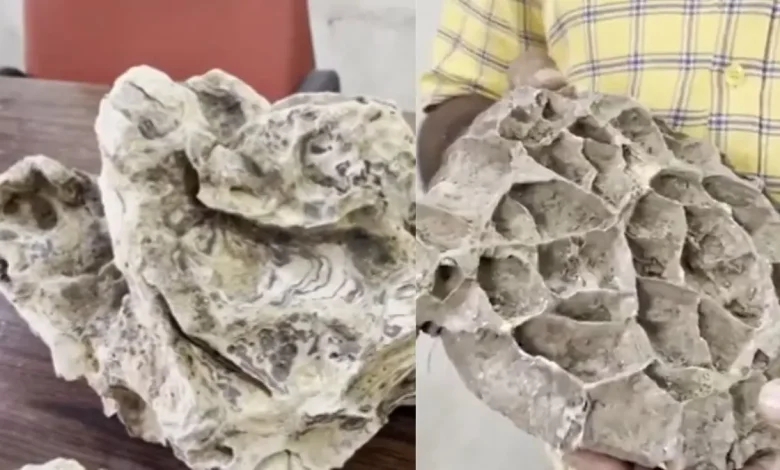
Mayurbhanj: A routine field trip by college students in Odisha’s Mayurbhanj district has led to the discovery of fossils estimated to be around 15 million years old, drawing attention to the region’s rich geological and natural heritage. According to a report by The Economic Times, the fossils were found near Baripada and are locally known as “Asura Hadda,” a term that translates to “demon bones.”
The discovery was made when researchers and students observed unusual fossil-like remains in the area. Further examination revealed several fossil specimens, including marine remains that could provide valuable clues about the region’s prehistoric environment.
Evidence of an Ancient Marine Ecosystem
Researchers involved in the study reported finding microfossils, including shark teeth and vertebrae, indicating that the region was once part of a marine ecosystem millions of years ago. The findings suggest that present-day Baripada, located inland, may have been submerged under the sea during the Miocene epoch.
Experts noted that the presence of marine fossils supports geological evidence that the coastline was significantly different millions of years ago. The discovery is expected to contribute to a better understanding of eastern India’s environmental and geological evolution.



#WATCH | Odisha: Almost 15 million-year-old fossils from the Miocene period were found in Baripada town of Mayurbhanj district. pic.twitter.com/MsZybpiDtF
— ANI (@ANI) June 18, 2026
Odisha’s Growing Importance in Archaeological and Geological Research
The latest find adds to a series of significant discoveries across Odisha that have highlighted the state’s ancient history and geological wealth. In recent years, researchers have uncovered evidence of prehistoric settlements, ancient tools, rock art, and fossil deposits across different regions of the state.
The discovery in Mayurbhanj further strengthens Odisha’s position as an important centre for archaeological, paleontological and geological research, offering insights into both India’s natural history and the evolution of life on the subcontinent.
Calls for Preservation and Scientific Study
Researchers have emphasized the need for detailed scientific analysis of the newly discovered fossils. Efforts are reportedly underway to collaborate with paleontology institutions to identify all recovered specimens and determine their significance
The discovery has also renewed discussions on preserving the fossil-rich region and promoting it as a geo-heritage site. Experts believe the area could emerge as an important destination for scientific research, education and geo-tourism while helping showcase India’s rich prehistoric legacy to a wider audience.
As investigations continue, the “Asura Hadda” fossils are expected to provide valuable information about the ancient ecosystems that once existed in eastern India. The find serves as another reminder of the country’s vast and largely unexplored natural heritage, offering researchers an opportunity to deepen our understanding of India’s geological history.
Also Read: HM Amit Shah Meets US Ambassador Sergio Gor In Delhi