
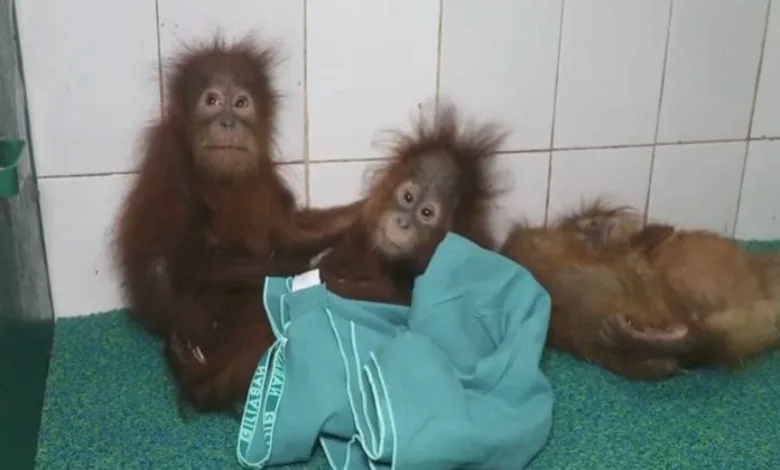
The discovery of five baby orangutans in a jungle in the eastern Indian state of Odisha, far from their usual habitat, has prompted an inquiry into how they got there.
The juvenile apes are seen eating bananas while sitting together on the forest floor in widely circulated photos and videos on the internet, thousands of kilometers away from their native tropical rainforests.
India is not the home of orangutans. Only Indonesia and Malaysia are home to the highly endangered apes in the wild.
Investigators are looking into whether the animals were brought into the nation by a global smuggling network and left next to a highway, according to Odisha’s forest minister.



After locals saw the orangutans and notified forest officials, they were rescued early on Tuesday in the Balasore area.
After receiving first aid, they were brought to Nandankanan Zoological Park in Bhubaneswar, the state capital, where they remain under observation and quarantine.
Pratik Prakash Indalkar, the Balasore District Forest Officer, told that the animals may have been driven to Odisha because they could not have arrived there organically.
He stated, “The five animals were discovered in Ranakata, a proposed reserve forest in Bhogarai block, close to the West Bengal border. The area is not a dense forest and is primarily covered by casuarina trees.” Additionally, it is along a state highway.
According to reports, the Odisha government has also requested an investigation by India’s Wildlife Crime Control Bureau. The investigation involves police, forest officials, and a special task team.
The orangutans had just been in the area for two or three days, according to forest officials. No other orangutans or hints as to how the creatures arrived were discovered during a search of the forest, according to Indalkar.
Although some local sources indicate they are between one and two years old, officials believe that they were newborns. According to wildlife expert Biswajit Mohanty, their discovery is especially worrying because of their young age.
For a number of years, young orangutans usually stay with their moms as they acquire the skills necessary to live on their own. Additionally, female reproduction is sluggish, typically occurring just once every eight years.
Concerns over how they ended up in Odisha have been raised by the discovery of five baby orangutans together, thousands of kilometers from their usual habitat and without any adult animals in the area.
The International Union for Conservation of Nature, or IUCN, has designated the three extant species of orangutans, Bornean, Sumatran, and Tapanuli, as critically endangered.
Due to habitat degradation, hunting, and deforestation, their populations have drastically decreased over time.
Cites, the international agreement governing trade in endangered wildlife, forbids the international commercial trading of orangutans. Indian wildlife regulations also provide protection for them.
In spite of this, orangutans are still trafficked for individual collectors and as exotic pets.
Young orangutans had already been discovered in India. Two young orangutans were discovered abandoned in 2022 at a checkpoint close to the Assam-Mizoram border. Officials believed they had entered India via neighboring Myanmar.
Also Read – Why This Amazon Engineer Walked Away From ₹46 Lakh Package