
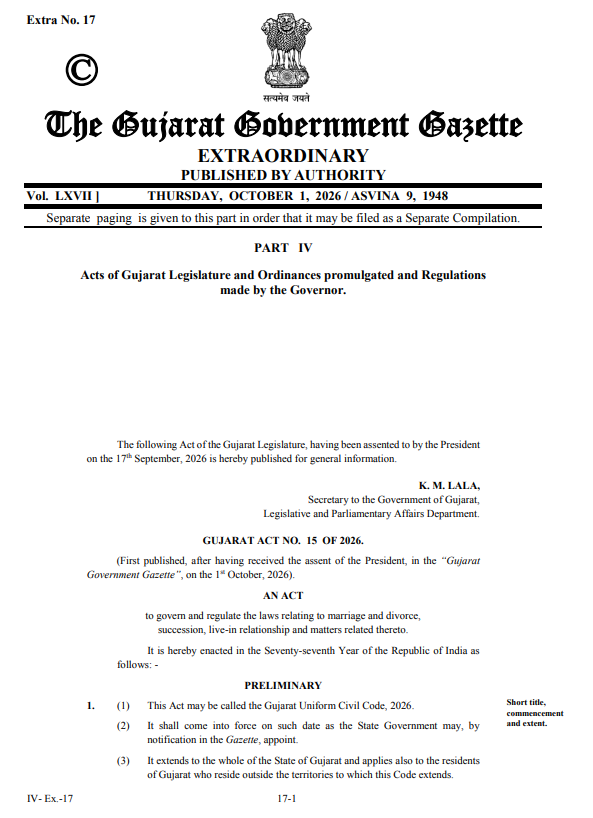
Gujarat’s Uniform Civil Code (UCC) Bill has become law after receiving the assent of President Droupadi Murmu, following the Governor’s approval. The Bill had earlier been passed by the state government in the Legislative Assembly. The law will come into force as soon as it is published in the Gazette, and women will now have equal rights in inheritance of property.
Key provisions of the law
Exemption for tribal communities

Members of Scheduled Tribes (ST) covered under Articles 366(25) and 342 of the Constitution, along with groups whose traditional rights are protected under Part 21 of the Constitution, have been exempted from the provisions of the law.
Mandatory registration of marriage and divorce
- Minimum age: The man must have completed 21 years of age and the woman 18 years at the time of marriage.
- Compulsory registration: All marriages solemnised after the law comes into force must be registered within 60 days. A penalty has been provided for failure to register within the prescribed period.
- Religious rituals unaffected: The law places no restriction on the traditional marriage rituals of any religion, such as Saptapadi, Nikah, Ashirwad and Anand Karaj.
- Monogamy: A person cannot marry again while their spouse is alive.
Strict rules for live-in relationships
Couples living in, or wishing to live in, a live-in relationship must register by giving a joint statement before the Registrar. If the relationship ends, the Registrar must also be informed through a joint or unilateral statement.
Also Read:Gujarat CM announces Smit Machchhar to Get Visisht Gujarat Garima Award
Equal inheritance and property rights
- Equal share: If a person dies without making a will (intestate), the spouse, children and parents will receive an equal share in the property under the law.
- Rights of children: Children born outside marriage, through surrogacy or by adoption have been given the same legal and inheritance rights as biological children.
Dispute resolution and court proceedings
Pre-litigation mediation has been provided as an option before approaching a court in disputes related to divorce or marriage. Marital status cannot be changed in employment records or government documents without marriage registration.
-

-
-

-