Ahmedabad: In a development stirring discussions on personal freedom and family involvement, the Gujarat government has introduced proposals requiring parental notification as a standard step in marriage registrations.
Under the planned amendments to the Gujarat Registration of Marriages Act, authorities would inform parents of both individuals within 10 days after the marriage application is filed.
The announcement came from Deputy Chief Minister and Home Minister Harsh Sanghavi in the state Assembly on Friday, framing it as a measure to address elopements and cases of alleged “love jihad.”
Sanghavi claimed that “innocent girls are being trapped” in such scenarios, likening the issue to “termites” eroding society, and stressed the government’s duty to intervene.
Critics, however, point to potential conflicts with constitutional rights, noting Supreme Court precedents that affirm adults’ autonomy in choosing partners.

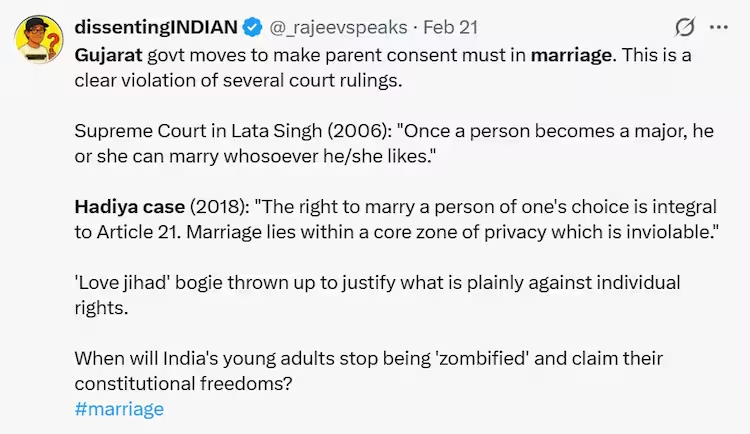
The 2018 Hadiya case, where Kerala resident Akhila (who became Hadiya) married Shafin Jahan, stands out. The apex court overturned a Kerala High Court annulment of the marriage, ruling that adult citizens can freely select spouses despite parental objections.
In that interfaith union, which sparked a nationwide “love jihad” controversy and involved a probe by the National Investigation Agency (NIA), the Supreme Court emphasized that “choices which individuals make on whether or not to marry and on whom to marry, lie outside the control of the state.”
Online commentators have referenced this verdict to challenge Gujarat’s proposals.
Key elements of the draft rules include: Couples must submit a declaration confirming if parents have been informed, along with parents’ names, addresses, Aadhaar numbers, and contact details to an Assistant Registrar.
Upon verification, parents receive notification within 10 working days, after which the application proceeds to the district or taluka Registrar. Registration occurs after a 30-day period if compliant, with details posted on a new government portal.
The Health and Family Welfare Department is soliciting public feedback for 30 days via its website before finalizing the rules.
Sanghavi clarified the government supports genuine love but will crack down on deceitful acts using false identities, which he said undermine sacred marital traditions.
In the Hadiya judgment, a bench headed by then Chief Justice Dipak Misra, with Justices AM Khanwilkar and DY Chandrachud, affirmed that “expression of choice in accord with law is acceptance of individual identity.”
The court rejected “love jihad” claims, upholding Hadiya’s conversion to Islam and stating that faith is central to personal existence, and depriving choice on faith grounds is unacceptable.
Addressing her father’s concerns, the bench noted that while he might perceive a “transgression” of his protective rights, it cannot override her fundamental freedoms.
Justice Chandrachud’s concurring view highlighted that partner selection is private under Article 21 of the Constitution, and intimacies of marriage are beyond state interference. “Courts as upholders of constitutional freedoms must safeguard these freedoms,” he wrote.
Gujarat officials indicated that implementation will follow review of public input during the consultation phase.
Also Read : Netanyahu Calls Modi’s Upcoming Visit A ‘Historic Milestone’ In Israel-India Ties
-

-

-

-