
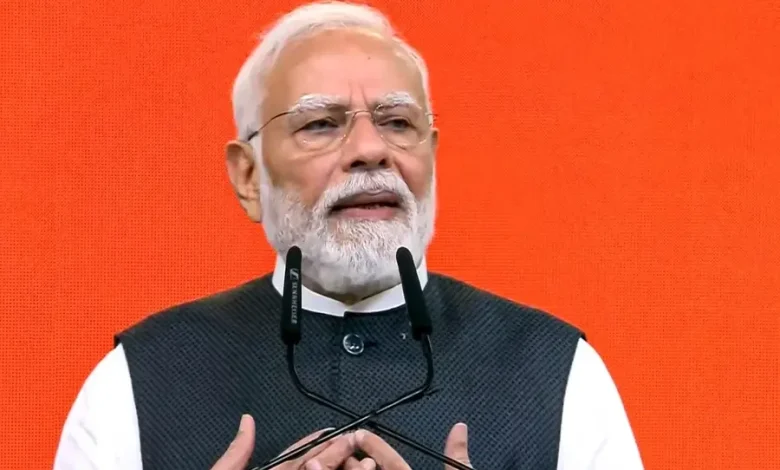
New Delhi: Prime Minister Narendra Modi on Wednesday marked 25 years as the head of a government, recalling his journey from Gujarat Chief Minister to Prime Minister and thanking the people for their continued trust.
Speaking at the Viksit Bharat Sankalp Sabha in New Delhi, Modi said he had not imagined on October 7, 2001, when he first took oath as Gujarat Chief Minister, that he would reach such a milestone.
“Those who stood by me showed me the power of faith, those who opposed me taught me the power of democracy,” Modi said, describing his 25 year journey as a result of the people’s trust rather than a personal achievement.
He said he viewed public service as a mission, not a personal ambition, and paid tribute to India’s democracy and Constitution. Modi also recalled his early years, saying his eagerness to learn began during his school days and that he still considers himself a lifelong student.
A major theme of his speech was the vision of Viksit Bharat by 2047. Modi called for an Aatmanirbhar Bharat, making India a global manufacturing hub, taking the country into the world’s top three economies, hosting the Olympics and expanding India’s presence in space. He repeatedly emphasised confidence and ended with the message: “We will do it.”
Modi also spoke about the need to move beyond politics based on caste and community. He said problems such as lack of water, electricity and development affect people regardless of their social or religious identity. His answer, he said, was “saturation” ensuring that every eligible beneficiary receives government schemes without discrimination or exclusion.
The 25 year journey began in Gujarat, where Modi served as Chief Minister from 2001 to 2014. During that period, initiatives such as SWAGAT and Jyotigram became associated with his governance model. At the Centre, several Gujarat experiences were subsequently expanded through programmes such as PRAGATI.
Since becoming Prime Minister in 2014, Modi’s governments have introduced or expanded major initiatives including Jan Dhan Yojana, UPI and digital public infrastructure, GST, Make in India, welfare transfers, infrastructure development and healthcare programmes. His tenure has also included major decisions such as demonetisation, changes to Jammu and Kashmir’s constitutional status and large-scale welfare and housing programmes.
His government has highlighted major infrastructure expansion, railway electrification, manufacturing growth, national security measures and India’s growing role in global forums. The Chandrayaan 3 lunar landing, India’s G20 presidency and the country’s expanding digital economy have also become prominent markers of the period.
The journey has not been without controversy. Modi’s tenure has faced criticism over unemployment, inequality, the impact of demonetisation, institutional independence, press freedom and minority rights. His supporters, meanwhile, credit his governments with stronger infrastructure, welfare delivery, digitalisation, economic reforms and a more assertive global role.
After winning elections in 2014 and 2019, Modi returned for a third consecutive term in 2024, although the BJP did not secure a majority on its own and formed the government with its NDA allies.
Twenty five years after entering government in Gujarat, Modi now looks towards the next milestone building what he calls a developed, self reliant India by 2047.
For the Prime Minister, the anniversary was therefore less about celebrating the past than renewing the promise of service. As he put it today “We will do it.”
ALSO READ: Virat Kohli Rejects Claim of Payment for Premanand Maharaj Ashram Visits