
Kishan Desai
(kddesai.creative@gmail.com)
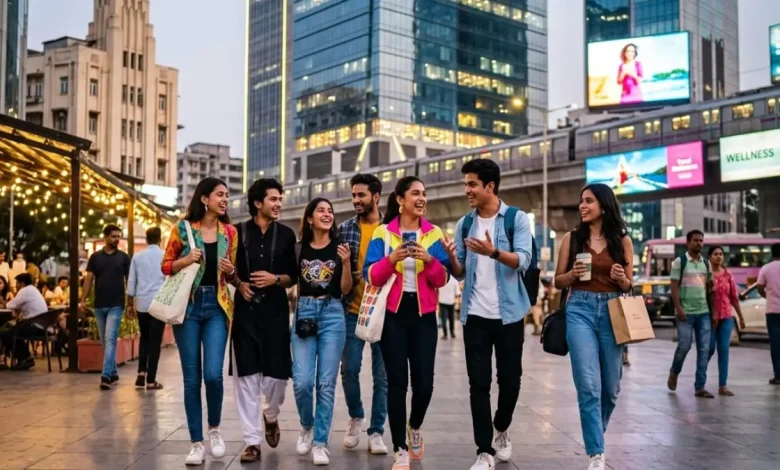
India’s economy is at the cusp of a significant and historic transformation, and at the heart of this change is Generation Z. According to the UN’s World Population Prospects 2024, India has more than 407 million young people(above 40.7 crores) between the ages of 14 and 29—nearly 28% of the country’s total population.
In the world’s most populous youth nation, Gen Z can no longer be viewed simply as a generation of digital consumers. Its influence is increasingly extending to how Indians work, spend, save, invest and build businesses. In many ways, this generation is emerging as a powerful force shaping the country’s economic trajectory.
As India moves towards its ambition of becoming a $5 trillion economy, the role of Gen Z will extend far beyond being the next generation of workers and consumers. Its choices, aspirations and economic participation could have a meaningful bearing on the country’s growth story.


Consumption, investment, government spending and exports and imports are the fundamental components of any economy. Among these, consumption plays a particularly important role.
In India’s traditional economy, consumption was largely driven by necessity. But Generation Z is changing that equation, giving rise to what can be described as an “inspiration economy”—one in which people are motivated by others, trends and circumstances to upgrade their lifestyles.
Consider the influence of content creators. A consumer may be inspired by a creator’s lifestyle and choose to buy clothes from a premium brand, not necessarily because they need them, but because they aspire to a particular lifestyle.
Millennials and earlier generations have traditionally placed greater emphasis on buying what was necessary, saving money and building long-term wealth through assets such as property. Gen Z, by contrast, appears to be placing greater value on experiences alongside traditional forms of wealth creation. Travel, cafés, fitness and personal care are increasingly becoming areas where young consumers are willing to spend on experiences rather than simply on products.
This shift in consumption habits is creating new opportunities for businesses. It has helped fuel the rapid emergence of D2C (Direct-to-Consumer) brands and given unprecedented momentum to India’s growing creator economy.
If we compare India with the US economy, the American model has long been heavily consumer-driven, with domestic consumption accounting for roughly 68–70% of GDP. In the 20th century, the enormous spending power of young Americans played a significant role in transforming the US into the world’s dominant economic power.
India is now witnessing a similar shift, with its growth engine increasingly moving towards a consumption-led model. What makes India’s position particularly significant is its much larger youth population compared with the United States.
This vast young consumer base is creating sustained demand for domestic manufacturers, e-commerce platforms and the MSME sector. As consumption becomes an increasingly important driver of growth, India’s large domestic market could also provide a degree of resilience against global economic slowdowns.
This consumption-led economy is playing an important role in India’s growth, with the economy expanding at a rate of 7.8%. For Gen Z, social media platforms such as Instagram, YouTube and Snapchat have effectively become the new-age shopping malls, creating a powerful ecosystem for emerging businesses and entrepreneurship.
Gen Z’s new approach to earning and spending is also giving India’s consumption story a different direction. More importantly, this generation has opened up entirely new avenues for earning. With little more than a smartphone, individuals can now build audiences, create content, launch businesses and, in some cases, earn substantial incomes.
The smartphone, therefore, is no longer merely a communication device for this generation. It has increasingly become a workplace, a marketplace and a gateway to new economic opportunities.
In conclusion, India’s Gen Z is more than just an age group; it has the potential to become one of the key engines of the country’s economic transformation. Its tendency to make inspiration-driven purchases, openness to new brands and growing earning potential are already influencing the direction of India’s consumption story.
Over the coming decade, industries and brands that understand and adapt to the mindset, aspirations and changing preferences of this young generation are likely to find themselves better positioned to engage with India’s evolving consumer market.
At the same time, a consumption-driven economy can make a large domestic market an important consideration for foreign businesses and investors. India’s expanding consumer base, entrepreneurial ecosystem and digital economy could therefore continue to attract international companies and investment, both directly and indirectly, in the years ahead.
However, this shift also comes with its own set of challenges. Inflation could emerge as a growing concern for the Indian economy. The economic pressures currently being faced by the United States also serve as a reminder that a consumption-driven growth model can carry risks for any economy.
India, however, has an important structural advantage: its long-standing culture of saving and investing. This traditional habit could prove valuable in maintaining economic stability and resilience.
The challenge now is to ensure that Gen Z does not move entirely away from this culture. Encouraging this generation to strike a healthy balance between consumption, saving and investment will be crucial in shaping India’s economic future.
In the years ahead, Gen Z will play an increasingly important role in shaping the direction of the Indian economy and strengthening its influence on the country’s economic future.
Read Also : Govt Rejects Foreign Hand In UPI Charges: What The New 0.4% MDR Rule Means For You