
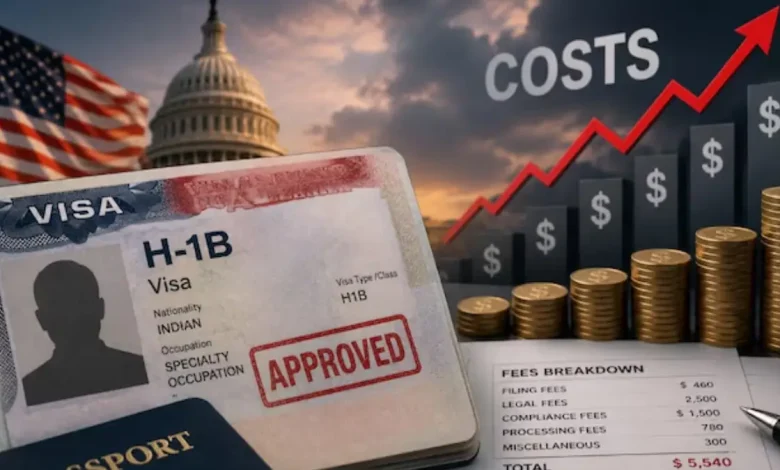
New York : For Indian students and technology professionals looking to build careers in the United States, the cost of getting there might be set to rise again amid all the increased scrutiny by the US President Donald Trump-led administration. The proposal of the potential charges comes after a tumultuous year for H-1B applicants, which saw the Trump administration introduce $100,000 payment requirement for certain H-1B petitions before the fee was struck down by a federal court.
New York-based Fragomen, one of the world’s leading corporate immigration law firms, said in a note on August 21 that US DHS has started the regulatory process for new fees affecting the H-1B and F-1 OPT programmes. According to the law firm, “a proposed OPT fee rule was sent to the Office of Management and Budget (OMB) on August 20 for review.” A separate proposal concerning a fee on certain H-1B petitions was received by OMB and cleared review on August 19. The Fragomen cited recent news reports and suggested that “DHS could propose a fee of as much as $100,000 for OPT applications.”
A Massachusetts federal district court vacated the policy on June 8, finding that the administration had exceeded its authority and that the fee amounted to an unlawful tax. The Trump-led government appealed, but the First Circuit Court of Appeals declined to stay the lower court’s order in July. That means USCIS cannot currently collect the $100,000 payment under that policy. Now, Fragomen revealed that the DHS is considering a new regulatory route for an H-1B fee, making the latest proposal particularly significant.
Employers may also pay for premium processing and legal representation, taking the total cost substantially higher. The important point for Indian H-1B workers is that most mandatory H-1B petition fees are employer costs, rather than expenses that the individual worker is expected to pay. Many Indian students enter the US on an F-1 student visa, complete their degree and then use OPT to work in their field. STEM (science, technology, engineering, and mathematics) graduates can subsequently qualify for a STEM OPT extension, giving them additional time to work before potentially moving to H-1B status.


And unlike the H-1B petition, where the employer generally bears the mandatory petition costs, OPT is an individual application, meaning the student typically bears the filing cost. This is why reports of a possible $100,000 OPT fee have generated particular concern. The $100,000 figure is only a reported possibility at this stage, not a confirmed DHS fee. The US does not impose these immigration fees based on nationality. An H-1B or OPT fee would generally apply according to the immigration category and circumstances of the application, not because someone is Indian.
Read Also : New Zealand Mulling Banning Children Under 16 From Social Media