
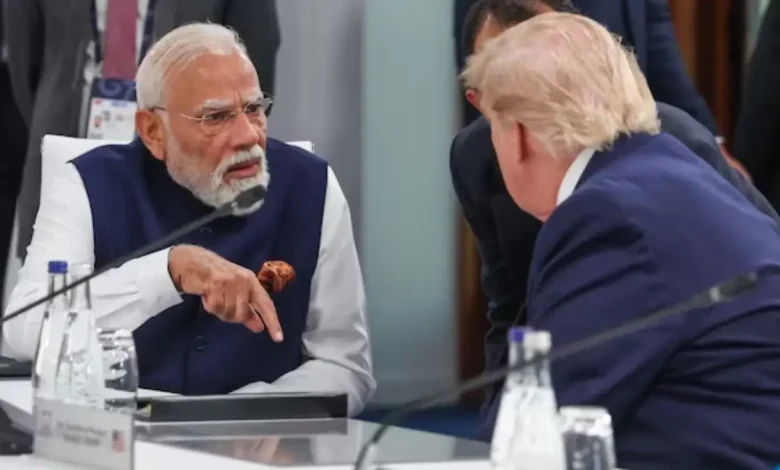
US President Donald Trump has expressed condolences over the deaths of three Indian seafarers killed during American strikes in the Strait of Hormuz, describing seafaring as an inherently dangerous occupation that has claimed lives across history.
Speaking to reporters at the G7 summit in France, Trump responded to questions about a message for the victims’ families. “I heard about that,” he said. “It’s a rough profession, no question about it. This has been happening throughout time.”
The remarks came during a bilateral meeting with Prime Minister Narendra Modi on the sidelines of the summit. The discussion highlighted strong ties between the two nations and addressed regional security concerns amid efforts to resolve tensions in West Asia.
Trump used the occasion to reassure India of steadfast American support. He stated that as long as he remains in office, India would have a reliable partner in the United States, promising to stand by the country against any threats.


ALSO READ : U.S.-Iran Accord Halts West Asia Conflict, Reopens Vital Oil Route
On India’s growing global influence, Trump praised the country’s expanding role in international affairs, particularly under Modi’s leadership. “India plays a big role in everything as long as he is the leader,” he noted.
Modi, in turn, welcomed US initiatives aimed at ending the conflict in West Asia. He underscored the critical importance of maintaining open shipping lanes through the Strait of Hormuz for the global economy and emphasized the need to safeguard the large Indian maritime workforce. Hundreds of thousands of Indian seafarers operate on vital trade routes worldwide, making their protection a key priority, Modi said. He expressed confidence that any peace agreement would place the highest emphasis on ensuring their safety.
The two leaders also touched on broader cooperation. Trump described his conversations with Modi as highly productive, characterizing the prime minister as a skilled and tough negotiator who cares deeply for both his nation and the United States. Optimism was voiced regarding a potential bilateral trade agreement, with indications that a presidential visit to India could materialize in the future, though no specific timelines were provided.
The exchange reflected the deepening strategic partnership between India and the US, balancing immediate humanitarian concerns with long-term economic and security collaboration in a volatile region. Freedom of navigation in key maritime chokepoints like the Strait of Hormuz remains essential not only for regional stability but for worldwide commerce.