From Tehran To Stanford: Meet Maryam Mirzakhani Became The First Woman To Win Nobel Prize Of Maths
In a world that often reduces Iran to headlines of geopolitics and conflict, a quietly determined mathematician from Tehran rewrote that story with nothing more than ideas, diagrams, and an insatiable curiosity. Her name was Maryam Mirzakhani the first woman in history to win the Fields Medal, the prize widely considered the Nobel Prize of mathematics.
Her path from the streets of Tehran to a professorship at Stanford University reads almost like the novels she once dreamed of writing.
The Girl Who Once Dislike Maths
There is an irony at the heart of Mirzakhani’s story: she did not begin as a mathematics prodigy. Growing up in Tehran, she was a devoted reader of novels who pictured herself becoming a writer one day. Mathematics, in those early years, simply did not interest her.
The turning point came when a teacher introduced her to mathematical puzzles. Gradually, her perception shifted. She stopped seeing mathematics as a collection of rigid formulas and began to see it as something closer to storytelling problems unfolding like the plot of a complex novel.




That shift proved extraordinary. As a teenager, she won two gold medals at the International Mathematical Olympiad, widely regarded as the world’s most demanding competition for young mathematicians. In 1995, she achieved a perfect score.
Shattering an 80-Year Barrier
In August 2014, at the International Congress of Mathematicians in Seoul, Mirzakhani received the Fields Medal — an honour that had been awarded exclusively to men since its introduction in 1936. With a single award, she broke a barrier that had stood for nearly eight decades.
Her research centred on geometry and dynamical systems, exploring the behaviour of curved surfaces and abstract spaces. While these may sound purely theoretical, they carry implications for fields ranging from theoretical physics to understanding the geometry of the universe itself.
A Private Life Behind the Public Achievement
Despite her global recognition, Mirzakhani led a remarkably understated personal life. She married Jan Vondrk, a Czech theoretical computer scientist, and the couple had a daughter named Anahita. The family settled in California after Mirzakhani joined Stanford University as a professor of mathematics.
Outside her research, she remained a devoted reader the literary passion of her childhood never left her. Those who knew her described her as thoughtful, humble, and deeply curious, someone equally comfortable in long intellectual discussions and quiet walks.
The Woman Who Painted Mathematics
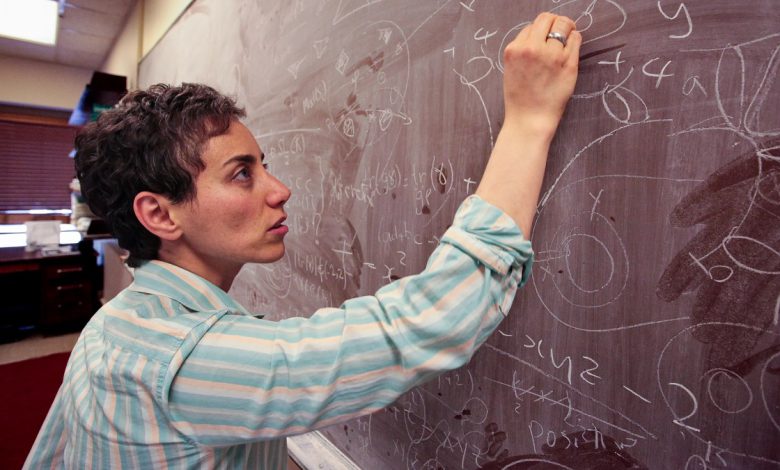
Mirzakhani’s working method was unlike most. Rather than filling notebooks with neat equations, she preferred spreading large sheets of paper across the floor and covering them with sketches, shapes, and sprawling diagrams. To an outsider, it resembled abstract art.
Her daughter Anahita saw it that way too. Watching her mother work, she would say: “Mummy is painting again.”
But those paintings were intricate mathematical explorations visual maps of ideas that had challenged mathematicians for years. At Stanford, colleagues admired both her quiet brilliance and her deeply imaginative approach to the discipline.
A Legacy Cut Too Short
At the height of her influence, Mirzakhani was diagnosed with breast cancer. She continued her research even as she battled the illness, unwilling to let it interrupt her work. In July 2017, she passed away at the age of 40.
Also Read: BTS: Historic Netflix Live Broadcast from Gwanghwamun
Mirzakhani had never publicly spoken on the issue of the hijab. Having moved abroad for higher studies, she typically appeared without a headscarf in international settings, including during her years at Stanford. In Iran, where women are legally required to wear the hijab in public, media outlets had previously used older photographs of her for that reason.
Her death, however, moved the country in an unexpected way. Iranian newspapers broke an unspoken taboo, publishing her photograph without a hijab on their front pages as a tribute to the nation’s most celebrated mathematician a woman who had changed how the world perceived both mathematics and Iranian women in science.
What She Left Behind
Mirzakhani’s story continues to resonate with students who find mathematics intimidating. She demonstrated that even someone who once had little interest in the subject could go on to fundamentally reshape it.
Her philosophy was as clear as it was profound: the beauty of mathematics lies not only in reaching the answer, but in discovering the path that leads there.
Through that journey, Maryam Mirzakhani quietly became one of the most remarkable mathematical minds of the modern era.