
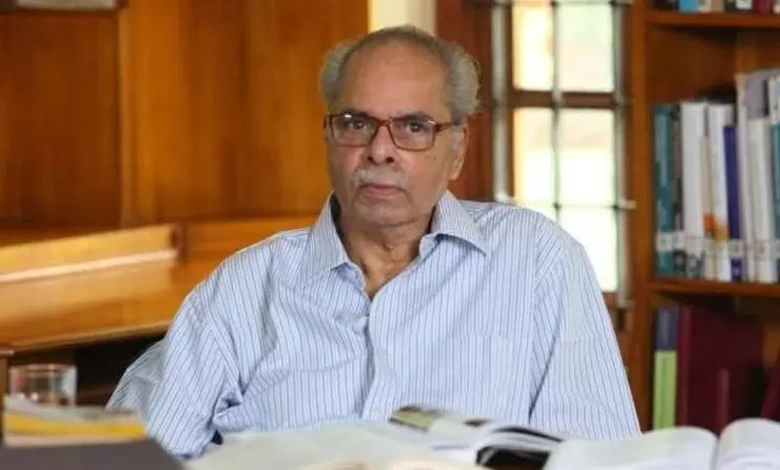
The noted Leftist scholar passed away on Monday at a private hospital in Thiruvananthapuram following age-related health issues. He was set to turn 90 next month.
Known affectionately as KN among peers, Panikkar played a key role in building the Centre for Historical Studies at Jawaharlal Nehru University (JNU), alongside historians such as Bipan Chandra, Sabyasachi Bhattacharya, and S. Gopal. He helped establish a robust program in modern Indian history.
Panikkar pioneered teaching on the history of ideas in 19th-century India during an era when historical scholarship focused mainly on economic and political themes. Through his work, he emphasized culture’s central place in shaping human actions and broader political movements, according to modern India historian Salil Misra.
He challenged colonial historiography’s oversimplified interpretations of culture and drew attention to how indigenous intellectuals, including Akshay Kumar Dutt and Lokahitawadi, developed their own forms of modernity without needing Western approval. These thinkers, he argued, presented valid alternative visions of a changing world.



ALSO READ : Who is Ujjwal Nikam, 26/11 Mumbai Attack Prosecutor, Nominated to Rajya Sabha by President Murmu
Panikkar also explored complexities in Indian knowledge systems under colonialism, such as traditions in Ayurveda, offering deeper insights into those processes.
Aditya Mukherjee, who was both his student and colleague, recalled Panikkar’s reputation as an exceptional teacher from his days at a Delhi University college. Invited to JNU in 1972, he brought social and religious reforms of the 19th century to life, engaging even students without prior history training, such as those from economics backgrounds.
Born in Guruvayoor, Kerala, Panikkar completed his undergraduate studies there before earning his master’s and doctorate from Rajasthan University. He later married his college classmate, the late Usha Bhargava. He served as the founding vice-chancellor of Sree Sankaracharya University of Sanskrit in Kalady.
Among his notable works is Against Lord and State: Religion and Peasant Uprising in Malabar. Kerala Chief Minister Pinarayi Vijayan, in a condolence message, praised Panikkar’s contribution in framing the Malabar rebellion accurately as a freedom struggle, agrarian revolt, and anti-imperialist movement.
Fellow historian R. Mahalakshmi highlighted that, though a committed Marxist, Panikkar engaged with topics beyond conventional Marxist frameworks, as evident in his essay “Culture and Consciousness in Modern India.”
M.G. Sashibhooshan noted Panikkar’s openness, recalling how he invited differing views on topics like Pattanam (Muziris) to academic forums.
Students and colleagues described his classrooms as vibrant spaces for debate, where he encouraged dissent and valued independent thinking, often rewarding challenging ideas.
Panikkar’s scholarship left a lasting mark on Indian historiography, particularly in defending secular, evidence-based approaches amid debates on culture, ideology, and communalism.