
H-1B Visa Fee Surges to $100,000 Under Trump Administration: Indian Professionals Face Uncertain Future
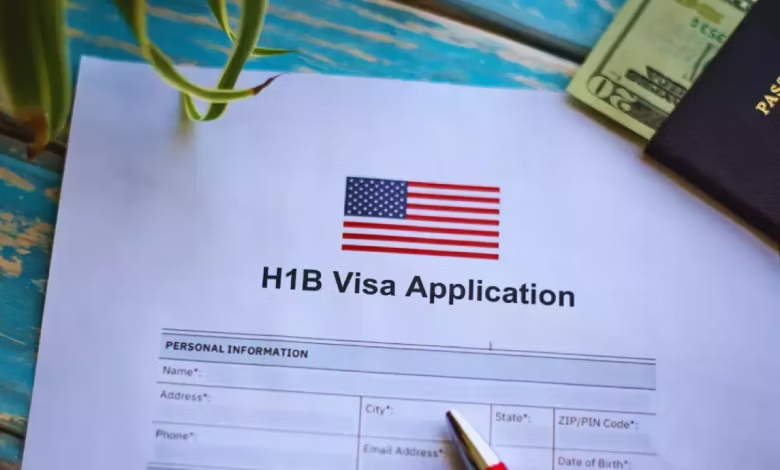
A partnership rooted in economic collaboration, technological advancement, and cross-border mobility between the United States and India now confronts significant challenges following immigration and trade reforms introduced during Donald Trump’s presidency. Measures including a dramatic increase in H-1B visa fees, tighter immigration protocols, and protectionist trade approaches are disrupting professional trajectories for Indian workers and challenging established frameworks that have facilitated global talent exchange for decades. The developments have triggered concern throughout India’s technology industry, expatriate networks, and international employment markets.
H-1B Visa Policy Transformation Marks Major Shift
Central to the current debate is an executive order from Trump mandating an annual $100,000 fee for employers sponsoring H-1B visas, representing a dramatic escalation from previous costs ranging between $2,000 and $5,000.
The H-1B program has served as a primary channel for skilled worker immigration to America, particularly benefiting Indian professionals across technology, engineering, medical, and research fields. Indian citizens have consistently represented the largest beneficiary group, comprising over 70% of approved H-1B visas in recent periods, filling essential positions throughout Silicon Valley and other tech centers. The substantial fee increase has created financial challenges for both Indian workers and sponsoring organizations, prompting urgent responses and travel warnings during the fall of 2025.
Market reactions followed swiftly. Major Indian IT corporations including Infosys and Tata Consultancy Services experienced stock price declines as investors assessed the consequences of diminished access to American employment markets. Observers contend that such prohibitive cost structures threaten to constrict the international talent flow that has sustained America’s technological leadership across multiple decades.




Policy Changes Impact Professional and Personal Lives
Consequences from these visa modifications reach well beyond financial statements:
Disruption occurred at international airports as workers rushed to re-enter the United States ahead of new regulation implementation, representing a significant departure from earlier periods when H-1B visa holders traveled internationally with limited complications.
Indian diaspora organizations have denounced prolonged visa processing timeframes and administrative obstacles, with some claiming these changes disproportionately affect Indian professionals who have already completed vetting procedures and maintain legal status in America.
Family relationships and personal circumstances face pressure as immigration pathways previously considered reliable employment channels become unstable or financially prohibitive, creating widespread apprehension among younger professionals.
For numerous individuals, a program formerly representing advancement and geographic flexibility now appears unpredictable and restrictive. Commentary from analysts and policy observers suggests the visa restructuring indicates a broader strategic recalibration in American policy, emphasizing immediate political considerations over sustained international cooperation. Initiatives such as elevated visa costs and tariffs are eroding what had been a reciprocally advantageous relationship founded on accessibility and collective economic growth. Indian technology professionals have contributed substantially to the American economy, participating in innovation development at leading technology companies while generating billions in tax contributions and trillions in economic value.
However, many interpret the new regulations as indicating those contributions receive less recognition than previously. The effects extend into strategic and diplomatic relations, diminishing confidence during a period when Washington has pursued New Delhi’s partnership on wider geopolitical matters. By restricting Indian professional mobility and workforce participation, critics suggest America risks distancing an important strategic ally while weakening its narrative as a global center for innovation.
Balancing Workforce Protection, Innovation, and Economic Nationalism
The Trump administration has defended the policy changes as components of an “America First” framework, designed to safeguard domestic employment and wage levels by increasing the expense of international hiring. Nevertheless, economists and business executives caution that such protectionist approaches may produce counterproductive outcomes. Economic experts warn that rendering H-1B visas financially inaccessible, functioning essentially as a levy on skilled talent, could damage both the American technology sector and broader innovation capacity, weakening competitive positioning. Analysts additionally observe that restricted mobility might encourage companies toward increased domestic recruitment or international facility investment, though such adjustments may not entirely compensate for diminished cross-border expertise. Critics maintain the policy fails to address fundamental concerns such as technological rivalry with China, instead redirecting focus toward immigration as an explanatory target.
Some observers propose these policy modifications could unintentionally accelerate India’s domestic technology sector development, as professionals opt to remain domestically or companies relocate regional operations to India, strengthening local innovation centers. Beyond geopolitical and economic dimensions, the human impact of these policy transformations remains significant:
Processing delays for visa appointments and rescheduling extending into 2027 have left numerous professionals unable to travel abroad, preventing attendance at family occasions such as weddings or caring for ill relatives without jeopardizing American employment positions.
Younger professionals, particularly those utilizing Optional Practical Training and early-career programs, have voiced considerable uncertainty and frustration regarding what previously represented a clear pathway toward American employment opportunities.
Sentiment among many within the Indian diaspora reflects perceptions of unfair targeting, a viewpoint that has generated international discussion and advocacy efforts.
Future Directions: Adaptation or Strategic Realignment
While immediate impacts present difficulties, certain experts identify possible long-term developments:
India’s technology industry might gain advantages if returning professionals and decreased dependence on H-1B routes stimulate domestic innovation, higher education advancement, and employment infrastructure.
Multinational corporations may expand international office locations and remote work frameworks, reducing concentration on American facilities and distributing opportunities more globally. This transition could prove complex, decentralizing talent networks while simultaneously limiting migration prospects.
Politically, strained relations concerning immigration policies may encourage India to broaden its international alliances and enhance its negotiating position regarding global workforce mobility.
The H-1B visa reforms under Trump, particularly the unprecedented $100,000 fee alongside comprehensive policy changes, have converted the visa from a desired opportunity into a complicated and expensive obstacle for Indian professionals. What previously symbolized partnership and mutual achievement now appears as a targeted restriction threatening careers, separating families, and destabilizing a foundation of bilateral relations. Yet within this disruption exists a contradiction: from limitation may arise new possibilities domestically, enhanced regional investment, and renewed dialogue about India’s position in the global innovation landscape. Should policymakers and industry leadership respond strategically to this moment, India may potentially transform this pressure into momentum for domestic advancement, even while managing the complex dynamics of its relationship with the world’s largest economy.