[By Devansh Desai Mumbai Samachar Desk]
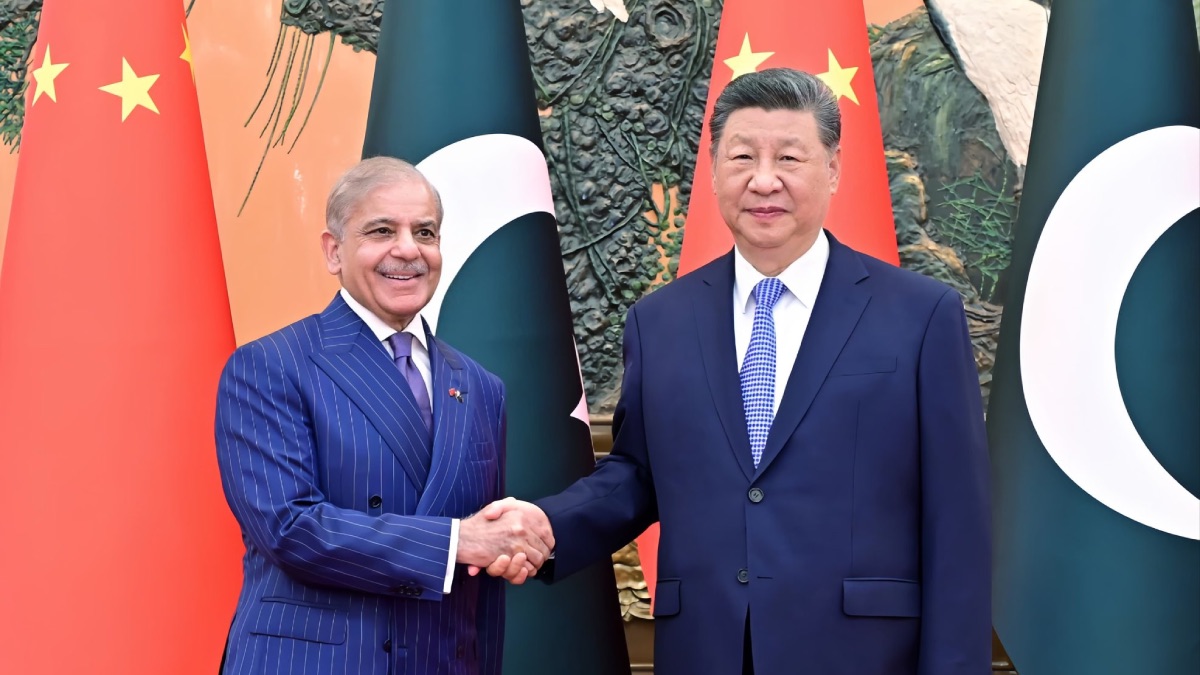
The joint statement from Shehbaz Sharif’s Beijing visit covers familiar ground Kashmir language, CPEC commitments, security cooperation but the sum of its parts deserves closer reading from New Delhi’s perspective.
Kashmir internationalised, again
India’s position on Jammu and Kashmir has been consistent since 2019: the abrogation of Article 370 was an internal administrative matter, and the issue is bilateral, not international. The joint statement cuts directly against that position by framing Kashmir as a dispute requiring UN-mandated resolution and explicitly opposing unilateral actions language widely read as a coordinated reference to the 2019 decision.
China has taken this position before. What is notable here is the degree of synchronisation the language is not incidental but appears as a formal, structured element of a bilateral statement timed for maximum visibility.
A more institutionalised defence axis
The formalisation of a China-Pakistan Security Partnership moves the relationship from strategic alignment which has existed for decades toward a more structured defence architecture. For India’s military planners, the distinction matters. An informal alignment can be read opportunistically; a formalised partnership with expanding hardware transfers and joint doctrinal development is harder to discount in operational planning.
India has long managed the reality of a two-front scenario. The question raised by this summit is whether the coordination between the two fronts is deepening in ways that compress India’s response options particularly regarding cross-border terrorism, where any escalatory move must now account for a more explicitly stated Chinese backstop.
CPEC’s next phase
India’s objection to CPEC has always rested on its routing through Pakistan-occupied Kashmir. That objection has not changed. What has changed is the corridor’s scope. The shift into digital infrastructure, mining, and agricultural technology means the economic integration between Pakistan and China is moving beyond roads and power plants into sectors that are harder to reverse and more deeply embedded in Pakistan’s economic structure. A neighbour dependent on Chinese capital and infrastructure is a qualitatively different strategic variable than one receiving Chinese weapons alone.
Also Read:At Least 4 Dead After Train Hits School Minibus at Level Crossing in Belgium’s Buggenhout
Pakistan’s diplomatic elevation in the Gulf
India has built substantial, independent relationships with Gulf states over decades through trade, energy, diaspora ties, and more recently through the India-Middle East-Europe Economic Corridor. China’s formal endorsement of Pakistan as a stabilising mediating actor in the West Asia crisis places Islamabad in a regional role it has not previously held. Whether Pakistan can sustain that role is a separate question. That China is actively backing it is not.
What India is actually dealing with
None of this is new in isolation. China has backed Pakistan on Kashmir before. CPEC has been expanding for years. Defence cooperation has deepened incrementally. What the Beijing summit does is consolidate these threads into a single, formally articulated framework at a moment when India is also managing the fallout of the India-Pakistan military confrontation, the West Asia disruptions, and the Quad meeting in Delhi.
New Delhi has tools: its Gulf relationships, its Quad positioning, its own economic weight, and the fact that US-China competition has not disappeared despite the Trump-Xi summit. But the Beijing statement is a reminder that the axis on India’s borders is not static. It is being actively upgraded.