
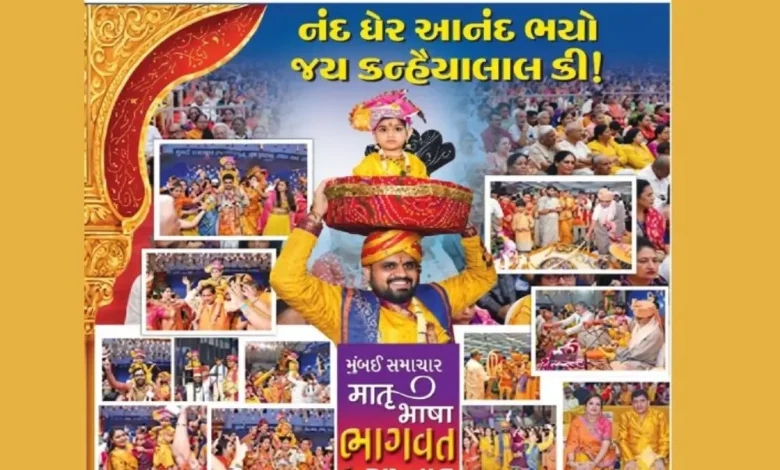
Mumbai : Over 20,000 devotees remain present on the fourth day of ‘Matrubhasa Bhagwat Saptah’ organized by ‘Mumbai Samachar’. Sanatan Nagri turned into Gokuliyu Gam as ‘Krishna Janmotsav’ celebrated in the Katha on Sunday. Pujya Bhaishree welcomed the Manorati family, the co-Manorati family and thousands of devotees present on the occasion of Krishna’s birth.
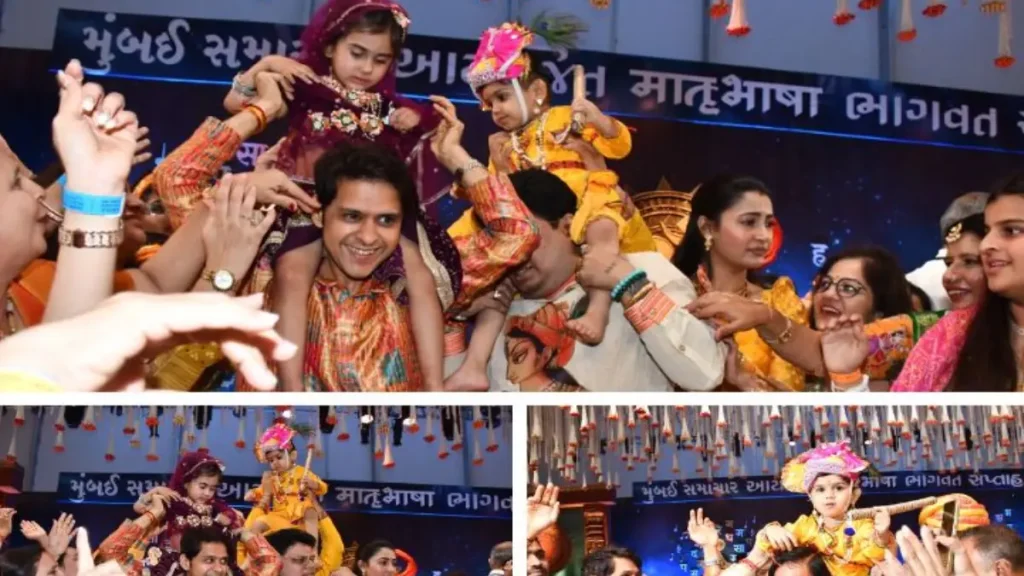
Vasudev had taken the child Krishna from Mathura in a bamboo basket, similarly when the main Manorati Mehta family brought the child in a basket decorated as the symbol of the child Krishna, a frenzy of joy reigned in the field. Along with the echo of ‘Nand Gher Anand Bhayo’, some people were also chanting ‘Yada Yada Hi Dharmasya, Glanirbhavati Bharat’. The enthusiasm for Krishna’s birth spread in such a way that it was as if Krishna had been born in every family present.
When the birth of Krishna was announced from the mouth of Bhaishree, the entire hall resounded “Nand Gher Anand Bhayo”, “Jai Kanayalalki and Jai Ranchhod”, “Makhan Chor” resounded. The entire atmosphere became Krishna-like. Manorathi family for ‘Krishnajanma’ Shri Saurabh Mehta and Shital Biren Sanghvi, celebrated the Krishna Janmashtami with great pomp and dance.
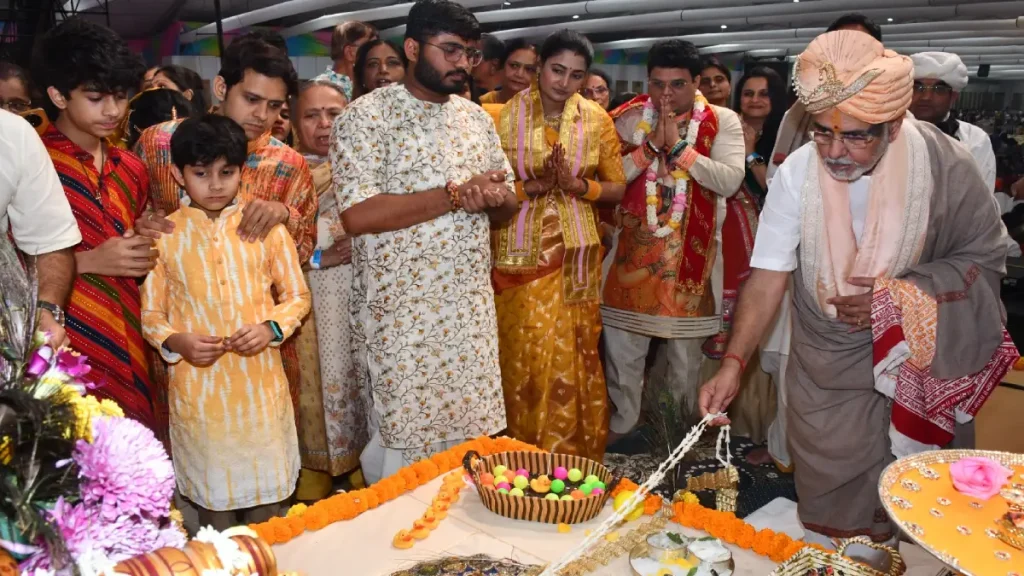
Pujya Bhaishree Rameshbhai Oza was talking about the 24 incarnations described in the Bhagavatam one after the other, and the devotees were listening with faith. When the talk reached Krishna Janmashtami, the devotees who were sitting on chairs with folded hands and listening to the Katha with a calm mind got into a frenzy and stood up on the spot and danced, turning the AC Dome into a Gokul village.



Bhaishree further spoke about the glory of language and said that Shrimad Bhagwat Mahapuran is a dialogue, Ram Katha is also a dialogue. Mahabharata is also a dialogue, all our Puranas are also a dialogue. Language is also a medium for dialogue. Emotions and thoughts are expressed through language. We can connect with the other person. Language can be symbolic and emotional.
Without saying anything, it can be understood only from your facial expressions. Language is written, read, but written language is eternal, because it is read for a long time. All our texts like Bhagwat, Ramayana, Gita are written in the divine language Sanskrit and the texts are a dialogue. Language means there is dialogue. If there is dialogue, it is easy to understand and if there is dialogue, there is clarity.
Regarding the society, Bhaishree said, ‘What society you come from, who you live with is very important. Both water and humans are very sensitive. Just as the color you put in water becomes like that, the effect of the people, society, and circumstances around a person is seen. Based on that, the ideological, emotional, and physical body of a person is built. Just think, can you abuse someone in Sanskrit? How would it feel to get angry in Sanskrit?