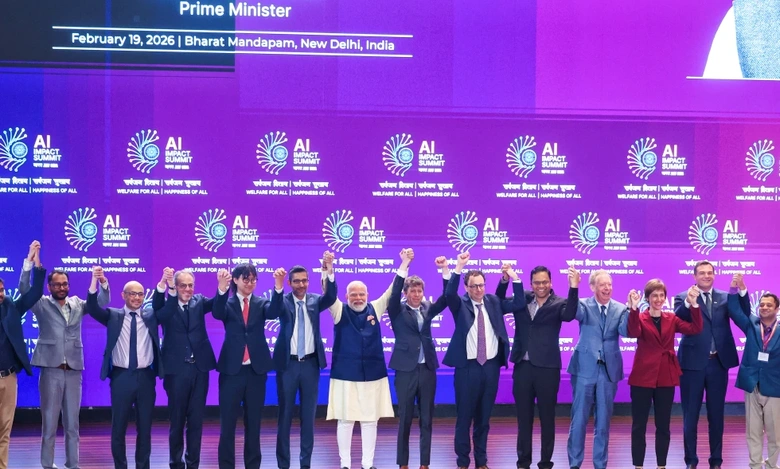
Indian Prime Minister Narendra Modi delivered a strong message at the India AI Impact Summit in New Delhi on February 19, 2026, positioning his country as a pivotal force in the worldwide artificial intelligence landscape. He emphasized India’s strategy of creating AI technologies domestically and extending their benefits globally, declaring, “Design and develop in India. Deliver to the world. Deliver to humanity.”
Speaking to an audience that included international leaders, tech industry chiefs, and policymakers, Modi stressed the need to make AI accessible and empowering, especially for developing nations in the Global South. He advocated for democratizing the technology to promote inclusion rather than leaving it controlled by a select few.
The summit, which has drawn significant attention as the first major global AI gathering hosted in the developing world, featured addresses from prominent figures such as French President Emmanuel Macron, Google CEO Sundar Pichai, and U.N. Secretary-General António Guterres. Guterres warned that AI’s direction should not be dictated by a limited number of countries or influenced solely by a few wealthy individuals, insisting that the technology must serve everyone.
ALSO READ : PM Modi Highlights India’s ‘MANAV’ Vision At Mega AI Impact Summit, Calls For Democratisation Of AI
In a separate session, Modi engaged with technology executives to explore investment opportunities in India. Participants endorsed guidelines for building AI that is inclusive and supports multiple languages.
OpenAI CEO Sam Altman revealed a partnership between his company and India’s Tata Group, focusing on AI projects and the establishment of data center infrastructure. Major commitments from global firms underscored India’s growing appeal: Microsoft pledged $17.5 billion over four years for cloud and AI infrastructure, Google committed $15 billion over five years—including plans for its first AI hub in the country—and Amazon outlined $35 billion by 2030 to advance AI-driven digital transformation. Indian authorities are targeting up to $200 billion in data center investments to support these ambitions.
India’s advantages include its vast digital public infrastructure—such as digital identification and payment systems—along with nearly 1 billion internet users, making it an attractive market and a potential model for affordable AI deployment in emerging economies. However, the country still trails leaders like the United States and China in developing large-scale indigenous AI models, constrained by challenges in accessing cutting-edge semiconductors, expansive data centers, and resources for its diverse linguistic landscape.
The event was not without issues: attendees reported long queues, logistical delays, and isolated incidents of theft, though organizers stated that stolen items were recovered. In one notable disciplinary action, an Indian university was removed from the summit after presenting a Chinese-manufactured robotic dog as its own creation. Additionally, Microsoft co-founder Bill Gates canceled his planned keynote address, with his foundation citing a desire to prioritize the summit’s core objectives, though no further explanation was provided.
A widely shared group photograph captured an awkward moment among AI competitors, including Altman and Anthropic CEO Dario Amodei, highlighting underlying tensions in the industry.
Through this summit, India has sought to bridge advanced economies and the Global South, reinforcing its role as a trusted partner in pursuing open, cost-effective, and development-oriented AI solutions.
-

-

-

-