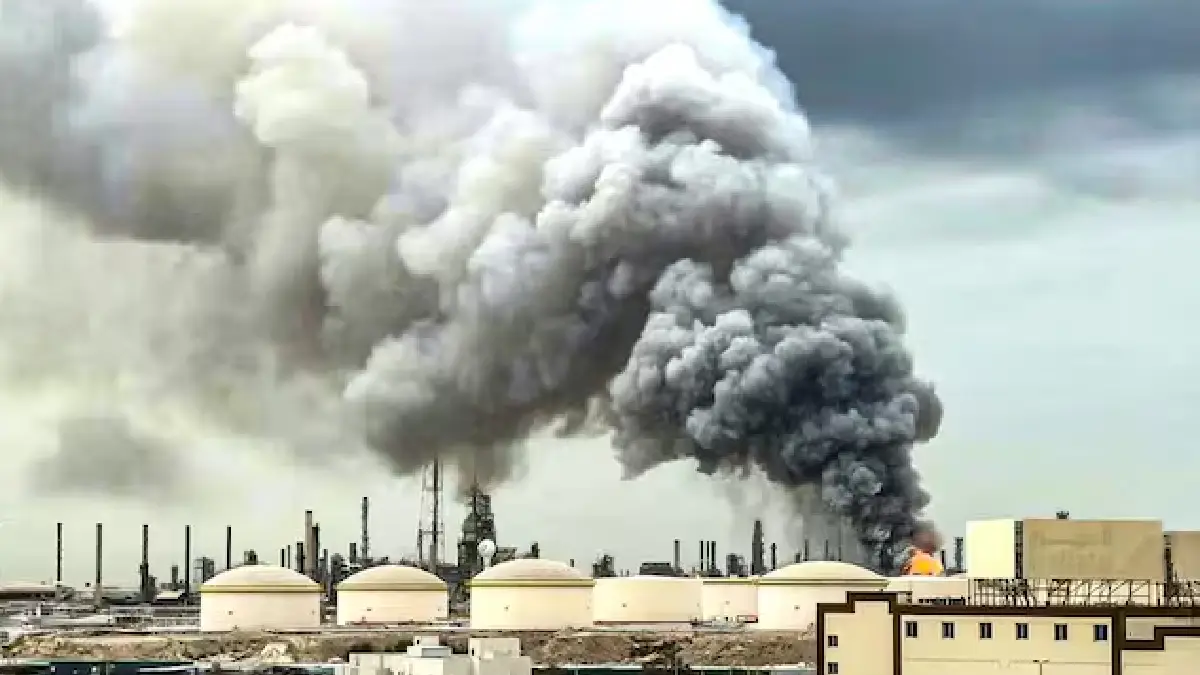
Tehran : It was a harsh truth that the world knew when the first Israeli missile landed in Iran around three weeks ago. What began as a fierce military confrontation between US-Israel and Iran has now spiralled into a full-blown “oil war” as the conflict entered into a more dangerous phase in the past 24 hours.
The US and Israel held back from targeting Iran’s energy production facilities in the Gulf. Even when US President Donald Trump attacked Kharg Island, the hub for 90% of Iran’s oil exports, only military sites were targeted. You may wonder why, as energy sites have been attacked previously, too. But the South Pars gasfield, the world’s largest, is the backbone of global LNG supplies, including India’s.
No wonder Trump was quick to distance the US from the attack on South Pars, claiming it was solely an Israeli operation. With the world already grappling with crude oil supply disruptions due to Iran blocking ship movements through the Strait of Hormuz, any damage to production facilities itself is likely to have a years-long impact.
South Pars is at the heart of its energy supply. About 80% of Iran’s electricity is generated from the gasfield. However, what complicates the issue is that this gasfield is not Iran’s alone. Iran shares it with Qatar, a US ally and the world’s largest LNG producer. Qatar’s section of the field is known as the North Field, from which large volumes of LNG are exported to global markets.
The developments are likely to have a significant bearing on India, one of the world’s largest LNG buyers. For this, India relies heavily on Qatar. In fact, around 80-85% of India’s LPG comes from Qatar and Saudi Arabia. A prolonged disruption will put supply chains under strain. LNG is mainly used by fertiliser plants and city gas networks, which supply PNG (piped gas) to households and CNG to vehicles.
Its seriousness could be gauged by the UAE’s rare rebuke for Iran, calling the strike a “terrorist attack” that threatened global energy security. Tehran has also vowed to strike oil and gas facilities in Saudi Arabia as well. Earlier this week, a drone attack by Iran saw operations at the Shah gasfield in Abu Dhabi being suspended. The gasfield is responsible for 8% of the world’s granulated sulphur supplies. It is mainly used in phosphate fertilisers.
The effect was visible immediately. Brent crude oil prices surged to $110 per barrel, while the benchmark gas price also jumped by 6%. In the US, gasoline prices hit their highest level since September 2023. Saul Kavonic, an analyst, told The Guardian that it takes years to repair damaged energy production infrastructure. “Hitting an LNG facility is the worst. It may take several years to repair,” he said.
Read Also : Trump Threatens Action Against Iran After Qatar Gas Facility Attack