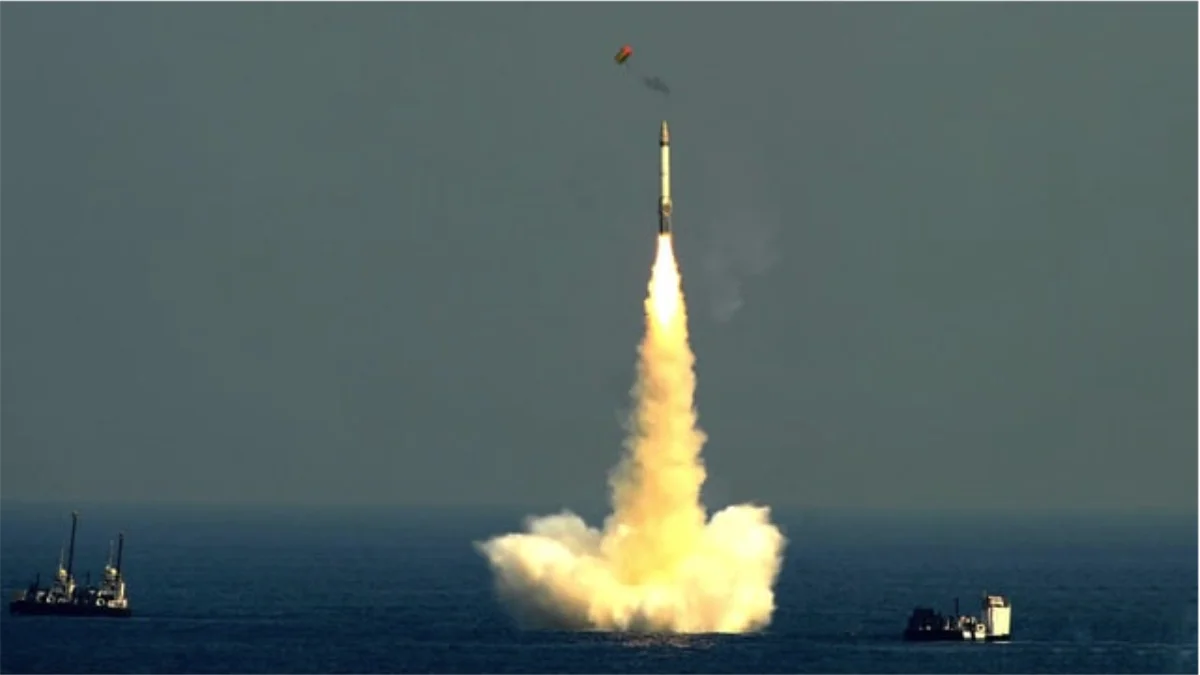
India has conducted a major validation of its undersea nuclear strike capability by successfully test-firing the K-4 submarine-launched ballistic missile (SLBM) from INS Arighaat. The trial was carried out in the Bay of Bengal, off the Visakhapatnam coast, on Tuesday, December 23, with defence sources confirming that the missile was tested to its full operational range. With a strike range of up to 3,500 km, the K-4 substantially boosts India’s sea-based nuclear deterrent.
INS Arighaat, the country’s second nuclear-powered ballistic missile submarine, entered service last year. This successful launch further strengthens India’s standing among the limited number of nations that maintain a fully operational nuclear triad, comprising land-, air- and sea-based nuclear delivery platforms. Inducted into the Indian Navy on August 29, 2024, the K-4 SLBM is derived from the Agni-III ballistic missile and has been heavily modified for underwater firing, allowing it to be ejected from a submarine silo, rise through the water, and ignite its rocket motor after breaching the surface.
The K-4 is designed to carry a nuclear warhead weighing up to 2.5 tonnes and can be launched from Arihant-class submarines. These submarines are built for extended, stealthy patrols in distant ocean expanses, ensuring a credible second-strike capability by remaining undetected.
As the most concealed leg of India’s nuclear forces, submarine-launched missiles such as the K-4 are central to deterrence, particularly in situations where land-based assets could be neutralised in a first strike. The K-4 also bridges the gap between the shorter-range K-15 missile and the longer-range SLBMs that are currently being developed for future induction. The ‘K’ series of missiles is named after former President APJ Abdul Kalam, who played a pivotal role in shaping India’s missile development programme.
-

-

-

-