
India and Israel are set to sign a landmark memorandum of understanding (MoU) on defence technology transfer, potentially granting India access to some of Israel’s most advanced and previously exclusive systems, including the Iron Dome rocket interceptor and the cutting-edge Iron Beam laser weapon.
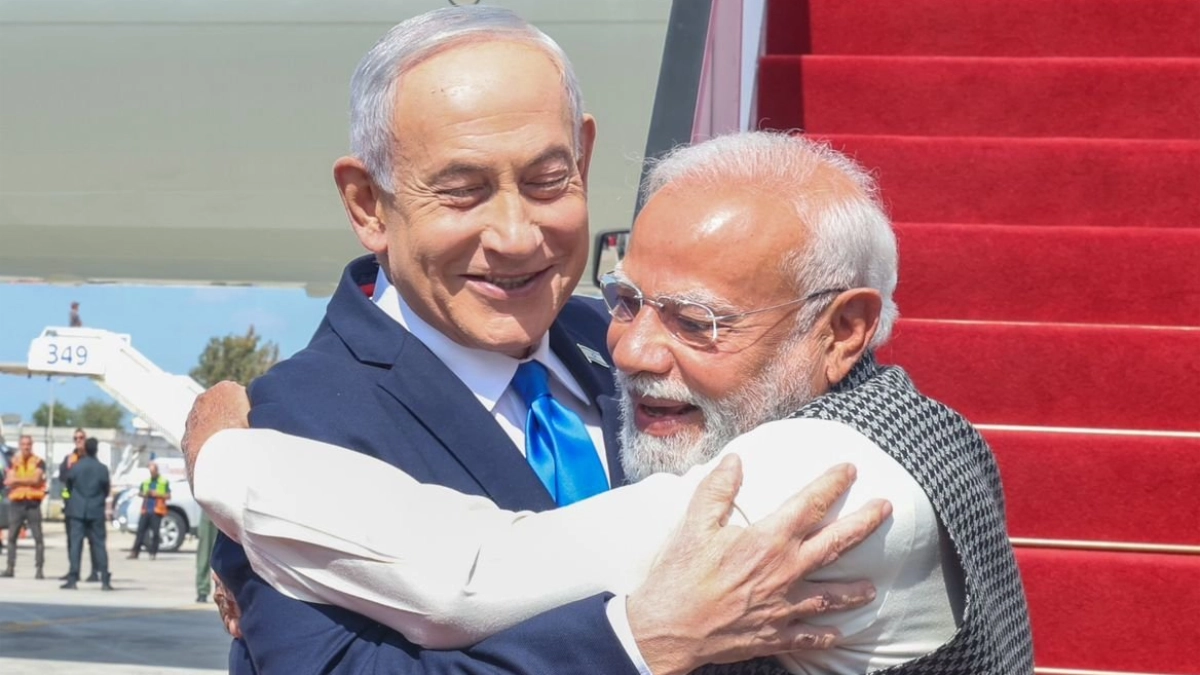
Prime Minister Narendra Modi arrived in Tel Aviv on Wednesday, where he addressed Israel’s Knesset, emphasising the importance of robust defence collaboration. “In today’s uncertain world, a strong defence partnership between trusted partners like India and Israel is of vital importance,” Modi stated during his speech.
Unlike previous deals focused on direct arms purchases, this agreement centres on technology sharing for high-end defensive and offensive platforms that Israel has not extended to other nations, as reported by The Times of India, citing local Israeli media.
The MoU is expected to cover two key areas: defensive systems and offensive capabilities.
In the defensive domain, discussions involve Israel Aerospace Industries (IAI)’s Arrow missile defence platform, Rafael Advanced Defense Systems’ David’s Sling (effective against medium-range missiles and drones up to 300 km), the Iron Dome (designed to neutralise short-range rockets between 4-70 km), and the joint Rafael-Elbit Systems Iron Beam—a 100 kW laser weapon capable of destroying aerial threats up to 10 km. Representatives from these Israeli firms have declined to comment on potential agreements.
For offensive systems, pacts may include Rafael’s SPICE 1000 precision guidance kits, Elbit Systems’ Rampage air-to-ground missiles, Ice Breaker naval cruise missiles, and IAI’s supersonic Air LORA missiles, with some arrangements reportedly already in place.
This push is driven by recent security challenges, including last May’s confrontations with Pakistan involving swarms of Turkish-origin drones and Chinese PL-15 long-range missiles targeting Indian positions. India currently operates Russia’s S-400, indigenous Akash systems, and Israeli Barak platforms but seeks enhanced layered protection.
The objective is to integrate transferred technologies under the Make in India programme to build an impenetrable multi-layered missile shield as part of the planned “Sudarshan Chakra” nationwide system by 2035. This would safeguard India’s 15,106-km land borders and 7,516.6-km coastline.
Talks could also explore the Golden Horizon, a next-generation air-launched missile succeeding the Sparrow series, featuring a 1,000-2,000 km range, Mach 5 speeds, and bunker-penetrating capabilities suitable for Sukhoi-30MKI integration—outpacing India’s BrahMos (Mach 3) in velocity.
The Iron Beam stands out for its affordability, with each laser engagement costing roughly $2, providing a economical supplement to missile-based interceptors.
Broader cooperation may include establishing a wider security framework. Israeli Prime Minister Netanyahu recently described India as integral to a “hexagon of alliances” encompassing Arab, African, Mediterranean (Greece and Cyprus), and Asian nations aimed at countering radical threats, including those associated with Iran’s regime.
-

-

-

-

