New Delhi : Carney will not be visiting Punjab, in a departure from the tradition followed by his predecessors, which was largely seen as a nod to the large Indian diaspora from the state. Since taking office last year, Carney has taken several steps to bury the ghost of Canada’s tumultuous relationship with India under Trudeau. The diplomatic thaw did not happen in a day. It took months to build. Stay with us as we explain how the stars aligned for India and Canada.
If we believed that India was actively interfering in the Canadian democratic process, we probably would not be taking this trip,” a senior government official told the media, CBC reported. It marked a decisive shift in Canada’s stance. In October 2024, the Trudeau government alleged links between Indian officials and violent criminal activity in Canada associated with the Lawrence Bishnoi gang.
A week ago, the Carney government silently moved to revoke the citizenship of 26/11 Mumbai attack accused Tahawwur Rana. Rana, a Lashkar-e-Taiba terrorist, is currently facing trial in India after being extradited from the US last year. While Canada has not explicitly stated the reasons behind its changed stance, officials highlighted a “systematic engagement” with India, including at the ministerial level, CTV reported. The collapse in relations began in September 2023 when Trudeau, days after returning from India, alleged the involvement of the Modi government in the killing of Hardeep Singh Nijjar outside a gurdwara in June.
At the heart of the diplomatic spat was the long-standing Khalistani issue, which involves the demand for carving out an independent state from Punjab. Over the decades, political perceptions in Canada around the Khalistani issue have increasingly been shaped by electoral maths. Carney, who took office in March 2025, has shown intent to move away from that path. PM Carney’s India visit signals that both Ottawa and New Delhi have decided that the costs of continued estrangement are too high.
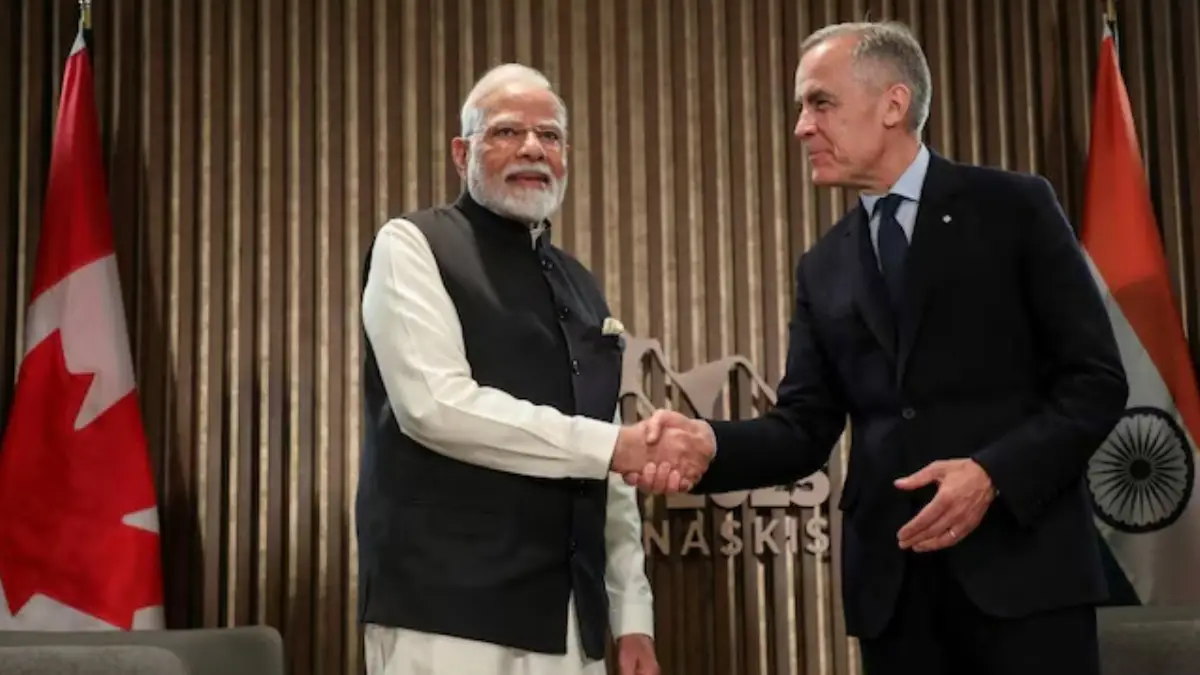
Mending of ties began after Carney personally invited PM Modi to the G7 summit in Kananaskis last year in June. The duo also held a separate meeting on the sidelines. A breakthrough was reached. The countries agreed to restore high commissioners and resume talks on a Comprehensive Economic Partnership Agreement (CEPA). Five months later, PM Modi and Carney met again. This time on the sidelines of the G20 Summit in Johannesburg. The leaders set an ambitious target of $50 billion in bilateral trade by 2030.
The reset has not been a one-way street. The trade chaos unleashed by US President Donald Trump has forced both India and Canada to rethink their strategy and global partners. For Carney, the Trumpian shock has been too hot to handle. Trump’s repeated characterisation of Canada as a potential “51st state” of the US, combined with tariff threats and economic pressure, has singed the Carney government.
The Canadian PM has gradually moved to reduce the country’s near-total reliance on the US. The US is Canada’s largest trading partner, accounting for 75% of all exports. It also absorbs 98% of Canada’s energy exports. Earlier this year, Carney made a historic visit to China, the first by a Canadian PM in eight years. Much to Trump’s resentment, Carney broke from US trade policy by doing away with tariffs on Chinese electric vehicles.
Read Also : BTS ARIRANG Album Collabs Leaked? Viral Post Leaves ARMY Guessing About Possible Performers