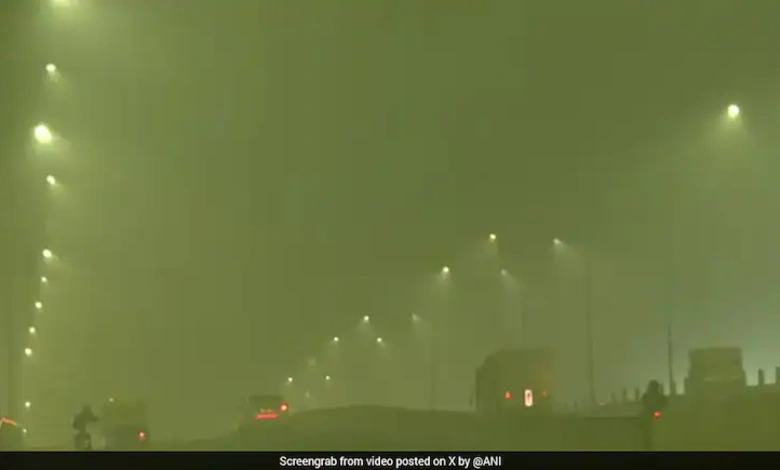
New Delhi was shrouded in a heavy blanket of smog on Sunday morning, with air pollution reaching severe levels across the city and causing reduced visibility, including at the airport.
According to the Central Pollution Control Board (CPCB), the city’s overall Air Quality Index (AQI) stood at 462 as of 6 am. Every one of the 40 monitoring stations recorded readings in the severe category. The highest figures included 499 in Rohini, North West Delhi, while Jahangirpuri and Vivek Vihar both registered 495.
Visuals shared by ANI from the Patparganj area on NH-24 highlighted the toxic haze enveloping the capital, where the local AQI was reported at 488—firmly in the severe range, as per CPCB data.
The AQI serves as a key indicator of air pollution’s impact on public health, calculated based on eight primary pollutants: PM10, PM2.5, ozone (O3), sulphur dioxide (SO2), nitrogen dioxide (NO2), carbon monoxide (CO), lead (Pb), and ammonia (NH3).
CPCB guidelines classify AQI as good (0-50), satisfactory (51-100), moderate (101-200), poor (201-300), very poor (301-400), and severe (401-500), with escalating health concerns in higher brackets.
In response to the deteriorating conditions, the Commission for Air Quality Management (CAQM) activated measures under Stage 3 of the Graded Response Action Plan (GRAP) on Saturday, later escalating to Stage 4 restrictions for the Delhi-NCR region.
CAQM attributed the sharp decline in air quality primarily to a weak Western Disturbance affecting northwest India, rather than local sources of emissions.
-

-

-

-