
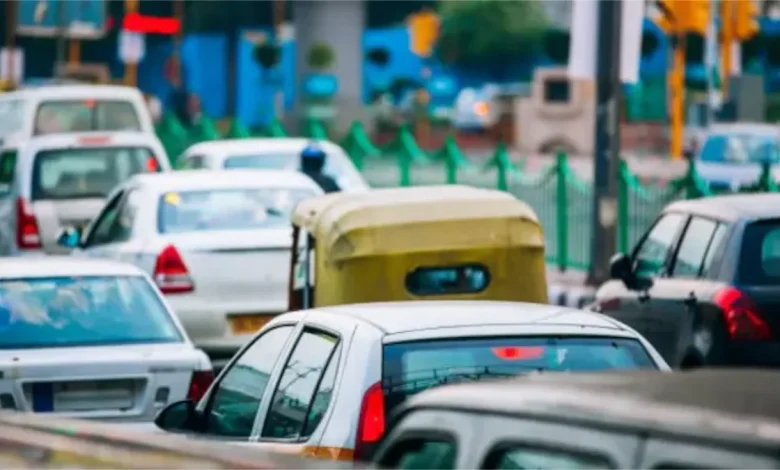
In a fresh crackdown to curb rising air pollution, the Delhi government on Wednesday banned the entry of vehicles that do not meet BS-VI emission standards into the national capital. Fuel stations across the city have also been directed not to sell petrol or diesel to vehicles that do not have a valid Pollution Under Control (PUC) certificate. The measures are being implemented while Stage IV of the Graded Response Action Plan (GRAP) remains in force.
Officials said the restrictions could affect nearly 12 lakh vehicles that enter Delhi every day from nearby cities, including Gurugram, Ghaziabad, Faridabad and Noida. As reported by NDTV, around 5.5 lakh vehicles from Ghaziabad, more than 4 lakh from Noida and nearly 2 lakh from Gurugram are likely to be turned back under the new rules.
To enforce the decision, the Delhi Police has deployed 580 personnel and 37 enforcement vans at 126 checkpoints placed at key entry points. Teams from the Transport Department and the Municipal Corporation have also been posted at petrol pumps to ensure compliance. Automatic Number Plate Recognition (ANPR) cameras installed at fuel stations will be used to identify vehicles without valid PUC certificates in real time.
Announcing the steps on Tuesday, Delhi Environment Minister Manjinder Singh Sirsa said the move was aimed at reducing vehicular pollution, which rises sharply during winter. The government cited studies indicating that vehicles account for about 19.7 per cent of (PM_{10}) and 25.1 per cent of (PM_{2.5}) pollution in Delhi during this season.




The government is also focusing on cutting emissions linked to traffic congestion by targeting 100 identified hotspots across the city. Officials said an integrated traffic management system is being developed to reduce signal waiting time, which they believe will lower fuel use and pollution.
Delhi’s air quality remains a concern, with the Air Quality Index (AQI) fluctuating between the severe and very poor categories since November. At 4 pm on Wednesday, the 24-hour average AQI was recorded at 334, slightly improved from Tuesday’s 354 but still far above safe levels.
Pollution is also set to dominate proceedings in Parliament on Wednesday, with the Lok Sabha scheduled to hold a short-duration discussion under Rule 193. Opposition parties, including the Congress, have been pressing for the debate for weeks. Union Environment Minister Bhupender Yadav is expected to respond at 5 pm.
Read More: Over 200,000 Indians Are Giving Up Citizenship Yearly; What’s Driving The Leave?
Public health measures continue as well. Physical classes for primary students remain suspended, while secondary and higher secondary students can opt for online learning. Government and private offices have been advised to operate with only 50 per cent staff on site as Delhi continues to battle hazardous air.