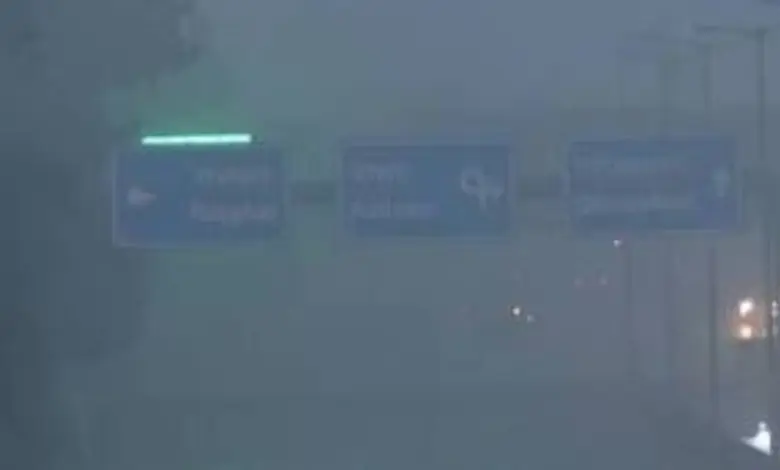
New Delhi: Delhi residents faced another day of dangerous air quality on Friday, as thick toxic smog enveloped areas like Anand Vihar. The Commission for Air Quality Management (CAQM) has implemented all restrictions under Stage-IV of the Graded Response Action Plan (GRAP) across Delhi-NCR to combat the escalating crisis.
Data from the Central Pollution Control Board (CPCB) showed several hotspots in the ‘severe’ category, with Ghazipur recording an AQI of 442, ITO at 409, and Palam at 447. The city’s average AQI was 330 as of early morning. Health officials urged vulnerable groups, including children, the elderly, and individuals with respiratory issues, to avoid outdoor activities due to the ongoing risks.
Dense fog compounded the problems, forcing Delhi airport to operate flights under low-visibility CAT III procedures and causing delays for multiple services.
The previous day, 15 of the city’s 40 monitoring stations registered ‘severe’ levels, according to the CPCB’s SAMEER app. Anand Vihar topped the list at 441, entering the ‘severe-plus’ zone, while 24 stations fell into ‘very poor’.
ALSO READ : Delhi Bars Entry Of Non-BS-VI Vehicles As Pollution Worsens; Fuel To Be Denied Without Valid PUC
Delhi’s morning AQI on Thursday reached 358. For context, AQI categories range from 0–50 (‘good’), 51–100 (‘satisfactory’), 101–200 (‘moderate’), 201–300 (‘poor’), 301–400 (‘very poor’), to 401–500 (‘severe’).
Analysis by the Decision Support System for Air Quality Management highlighted vehicular transport as the primary pollutant source in Delhi, contributing 18.3 percent. Industries accounted for 9.2 percent, residential emissions 4.5 percent, and construction dust 2.5 percent. Smaller shares came from waste burning (1.6 percent), road dust (1.3 percent), other sources (1.2 percent), and local power generation (around 1.2 percent).
Emissions from nearby NCR districts also played a major role, with Jhajjar adding 12.3 percent, Sonipat 8.8 percent, Rohtak 4.8 percent, Jind 3.1 percent, Bhiwani 1.4 percent, and Gurugram 1.1 percent.
-

-

-

-