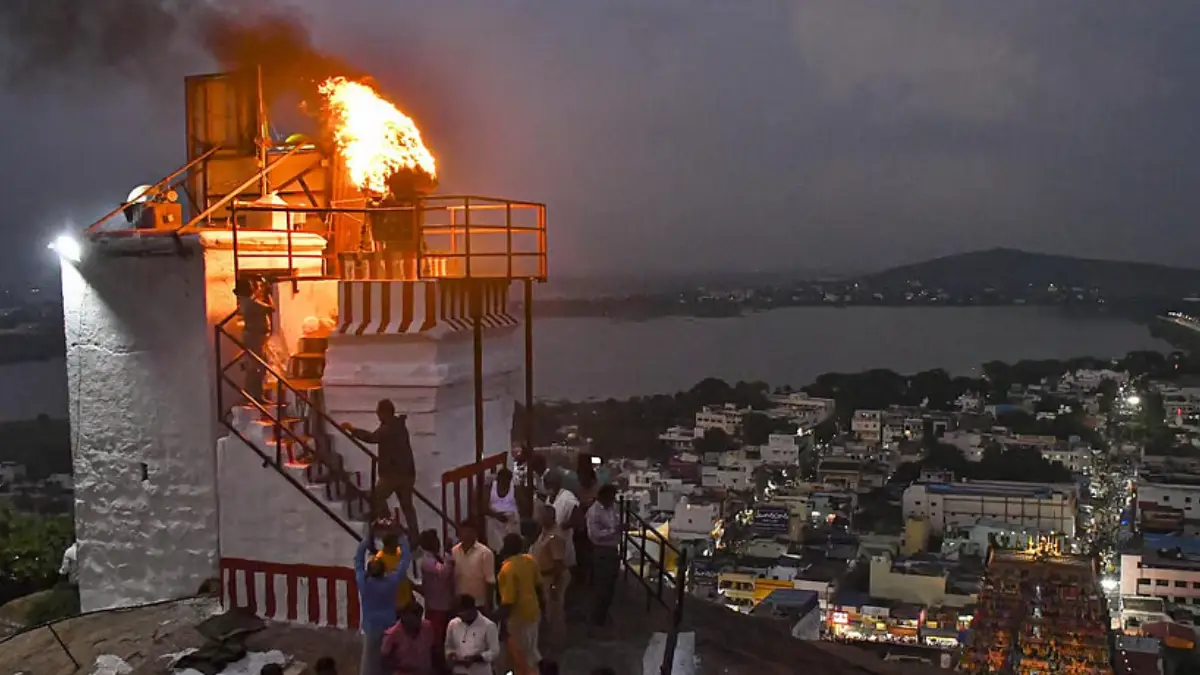
Chennai : The Madras High Court on Tuesday, January 6, upheld a single judge’s order directing the lighting of a lamp at the stone pillar. The issue before the court centred on whether Karthigai Deepam could be lit at an ancient stone lamp pillar located on the Thiruparankundram hills, close to the Hazarath Sultan Sikkandar Badhusha Avuliya Dargah, with the state and other appellants opposing the practice citing custom, law-and-order concerns
A division bench comprising Justice G Jayachandran and Justice KK Ramakrishnan held that the single judge’s order was not barred by res judicata, as the issue had not been conclusively decided in earlier litigations. Coming down strongly on the state’s objections, the bench termed it “ridiculous and hard to believe” that allowing representatives of the devasthanam to light a lamp on the stone pillar on a particular day in a year could disturb public peace.
The court observed that such disturbance could occur only if “sponsored by the state itself” and added that it hoped no state would stoop to such a level to further a political agenda. The judges also noted that claims that the pillar belonged to the dargah had added to the scepticism surrounding the mediation efforts cited before the court. The appeals arose from a December 1 order of a single judge directing the management of the Arulmigu Subramania Swamy Temple, Thiruparankundram, to light the Karthigai Deepam at the ancient stone lamp pillar on the hill.
Challenging the single judge’s order, the state, police, the dargah and the Tamil Nadu Waqf Board approached the division bench. The state argued that the devotees had no enforceable legal right to seek lighting of the lamp and that Article 226 powers could not be used to alter a long-standing custom. The Advocate General submitted that the petition was not a public interest litigation but a private one, and the court’s focus should be limited to the petitioner’s rights and the statutory obligations of the respondents.
The Executive Officer of the Arulmigu Subramania Swamy Temple contended that while a devotee could approach the court to protect an existing right, no such right could be assumed in this case. The Hindu Religious and Charitable Endowment Department told the court it was for the devasthanam to take a call on lighting the lamp, adding that it was open to consider any application moved by the petitioners.
The dargah, for its part, submitted that the minority community was facing difficulties in enjoying the land granted to it in 1920 and alleged that the single judge had not given it adequate opportunity to present its case. It claimed the court had framed a new case beyond the pleadings. The Joint Commissioner of the HR and CE departments argued that the pillar was not meant for lighting Karthigai Deepam but had been used by saints who once lived in the area.
The Madurai Collector and the Police Commissioner also opposed the order, arguing that the Deepathoon itself was a “figment of imagination” and pointed to practical difficulties in accessing the spot by climbing steps through the dargah premises. They maintained that the single judge’s directions could disturb peace in the sensitive area. The division bench upheld the single judge’s directions, clearing the way for lighting the lamp at the stone pillar atop the Thiruparankundram hills.
Praising the order, K Annamalai said on X that it was “difficult to comprehend how a mighty State could harbour the fear” that allowing devotees to light a lamp on a single day would disturb public peace. Quoting the court, he wrote that such a disturbance could arise “only if the State itself were to sponsor it” and said the judges had cautioned the Tamil Nadu government against “stooping to such levels.
Read Also : Father Disputes Ex-Boyfriend Label in Daughter’s Tragic US Murder Case
-

-
-

-