
Why Did Australia’s Sky Turn Blood Red Before Cyclone Narelle? Explained
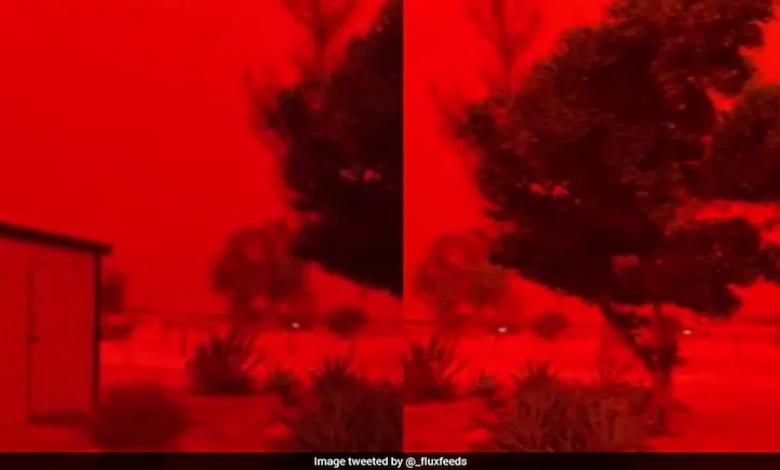
Perth: Parts of Western Australia witnessed an unusual and striking natural phenomenon as the sky turned a deep blood-red ahead of the arrival of Cyclone Narelle, drawing global attention, reported The Times of India.
The dramatic visuals, widely shared on social media, showed entire regions bathed in an eerie crimson glow, creating what many described as an apocalyptic scene. The phenomenon was observed in areas such as Shark Bay, where daylight appeared to dim under the intense red hue.
NO, that's not a filter! ☁️🔴 The sky turned an eerie shade of red in Western Australia as dust filled the air ahead of Tropical Cyclone Narelle. pic.twitter.com/dCQ2hjFluI
— AccuWeather (@accuweather) March 28, 2026
According to meteorological explanations cited by The Times of India, the unusual colouration was primarily caused by large amounts of dust lifted into the atmosphere by strong winds associated with the approaching cyclone. These winds carried fine particles of iron-rich soil from Australia’s arid interior into the air, forming dense dust clouds.




As sunlight passed through this thick layer of dust and moisture, shorter wavelengths such as blue light were scattered, while longer red wavelengths became more dominant. This scattering effect caused the sky to take on its distinctive reddish appearance.
Experts also noted that cloud cover and atmospheric conditions further intensified the effect. The combination of dust, clouds, and filtered sunlight created a uniform, dimly lit environment, enhancing the dramatic visual impact across the region.
While the visuals appeared alarming, the phenomenon itself is a known atmospheric occurrence, particularly in regions with iron-rich soil and frequent dust storms. However, the scale and intensity seen ahead of Cyclone Narelle made it a rare and widely discussed event.
As reported by The Times of India, conditions gradually returned to normal after the cyclone passed and the dust settled. The incident highlights how extreme weather systems can interact with local geography to produce visually striking yet scientifically explainable natural events.
Also Read: 12 Tonnes Of KitKat Stolen In Europe As Truck Goes Missing En Route To Poland