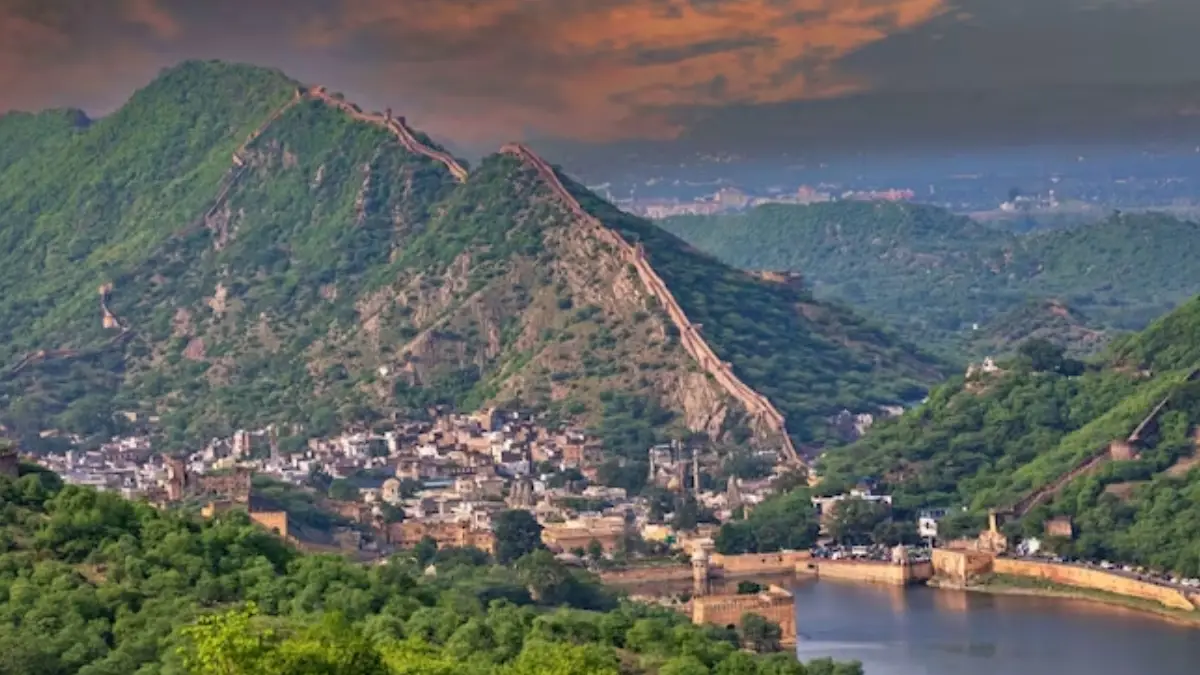
New Delhi : The Supreme Court on Monday said that certain clarifications were necessary regarding the definitions it recently approved for the Aravalli Hills. Supreme Court has “put in abeyance” its earlier decision (issued on November 20) to accept the Central Environment Ministry’s definition of Aravalli Hills and Aravalli Range. Acceptance of the said definition by the top court in November had exposed most of the Aravalli region to the possibility of being used for regulated mining activities.
The Supreme Court said that the environmental impact of recommendations made by an earlier panel on the Aravalli range must be examined by a committee of experts, noting that the previous panel was largely composed of bureaucrats. A bench comprising Chief Justice of India Surya Kant and Justices J.K. Maheshwari and A.G. Masih made the observation while staying the recent ruling on the Aravalli region.
The Court has also issued notice to the Centre and the four Aravalli States – Rajasthan, Gujarat, Delhi and Haryana, seeking their response to its suo motu case on the issue. The Supreme Court said that a fair and independent expert assessment is necessary before implementing either the earlier committee’s report or the court’s judgment on the Aravalli range, citing serious environmental and regulatory concerns.
Chief Justice of India said that an objective exercise was required to guide the court on key issues arising from the recommendations that sought to restrict the definition of the Aravalli range to a 500-metre belt. The court questioned whether such a narrow definition created a “structural paradox” by shrinking the conservation zone while potentially expanding areas where regulated mining could be permitted.
The bench also flagged concerns over whether the revised definition had widened the scope of non-Aravalli regions eligible for mining, and whether regulated mining should be allowed in geographical gaps between hill formations. It specifically referred to situations where two hill areas of 100 metres or more in height are separated by a distance of around 700 metres, asking how such gaps should be treated under environmental norms.
Emphasising the need to preserve the ecological continuity of the Aravalli range, the court said it must be examined how the structural integrity of the ancient hill system can be maintained. It added that if a significant regulatory lacuna is found, a comprehensive assessment may be required to address the shortcomings. We propose that a high-powered expert committee comprising domain experts be constituted to analyse the report submitted by the expert committee, the Chief Justice said, making it clear that scientific and environmental expertise must guide future decisions.
Read Also : Why Setting New Year Resolutions Remains Worthwhile, Even If They Don’t Last
-

-

-

-