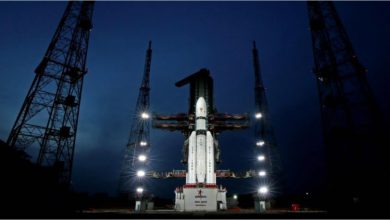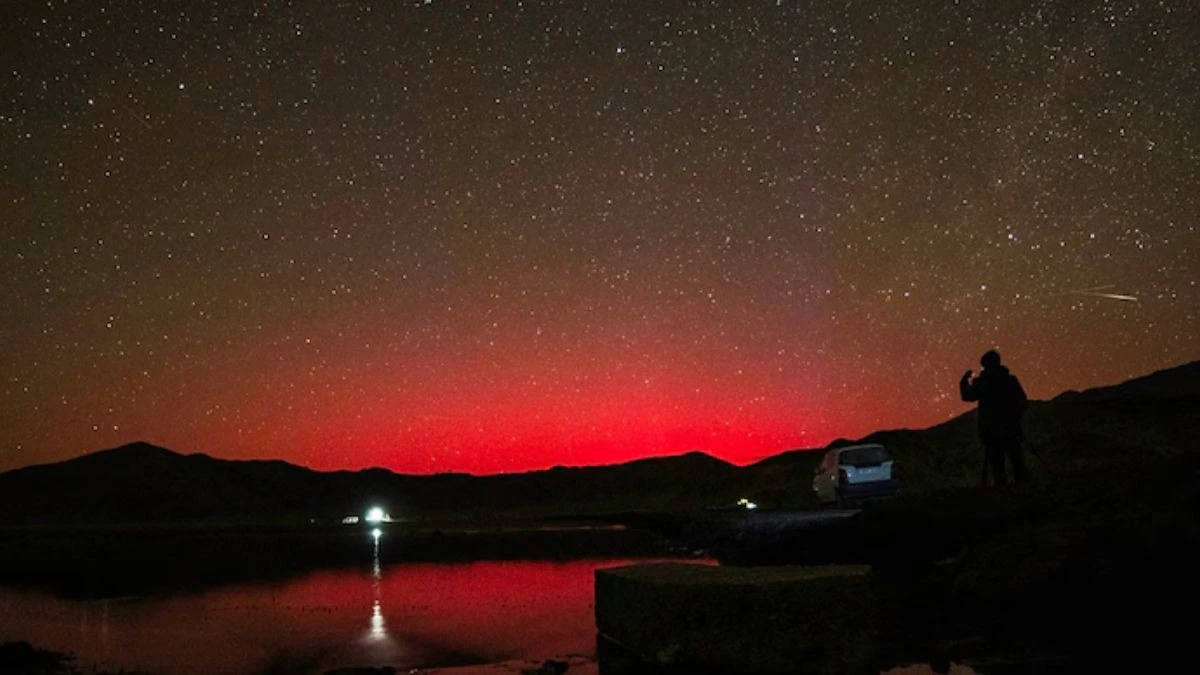
Hanle : Ladakh’s Hanle Dark Sky Reserve turned into rare red auroras illuminating the horizon in the night on January 19-20, 2026. People unaware of the scientific fact started thinking why did the sky turn bloody red? So let us decode for you.
Rare Red Auroras were a result of an S4 intense storm in solar radiation considered to be the worst storm since Halloween Events of October 2003 caused by a coronal mass ejection that strikes Earth, mainly the mid-latitude of the globe as India.
The views are captured by all sky cameras of the Indian Astronomical Observatory indicating high volatility of Solar Cycle 25. On one hand where the social media is flooded with images of these northern lights the scientific reasons make more serious warning to India. The sights are proof that the sun is becoming increasingly volatile, a crucial warning to India.
This flare hurled a massive cloud of magnetised plasma known as a Coronal Mass Ejection (CME) – toward Earth. Travelling at nearly 1,700 kilometres per second, the charged particles reached Earth’s magnetic field in about 25 hours, sparking a G4-level geomagnetic storm as they interacted with the upper atmosphere.

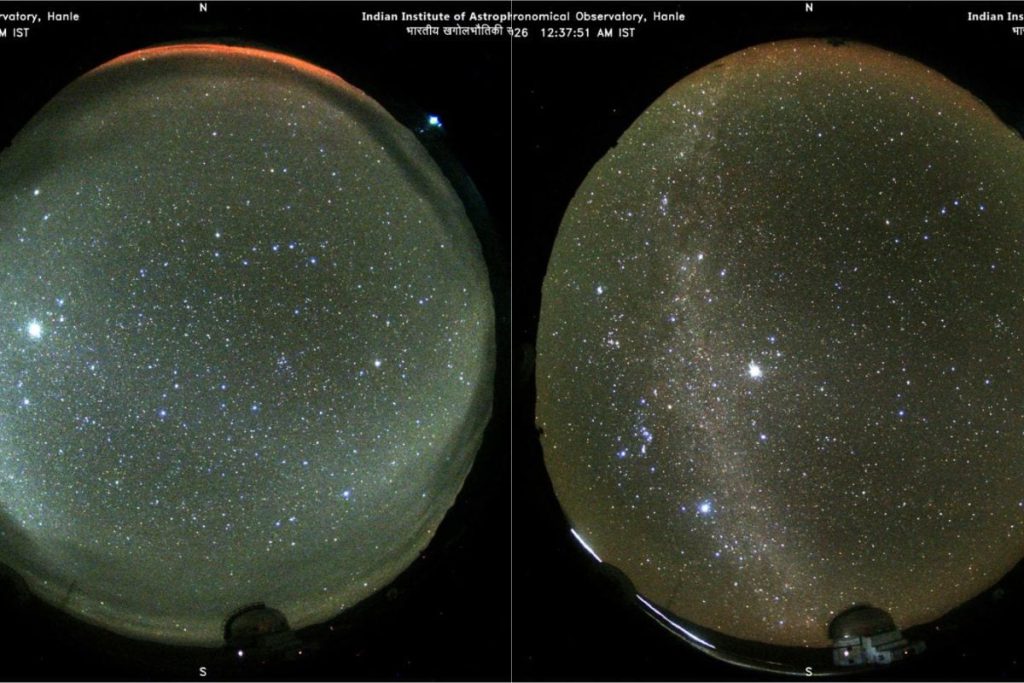
The deep red colour seen over Ladakh resulted from high-altitude oxygen atoms located more than 300 kilometres above Earth’s surface becoming excited by impacts from the fast-moving solar particles. At lower latitudes like Ladakh, observers see the tops of these energetic auroral displays, which appear red rather than the typical green hues seen in polar regions.
Also Read : The Fish That Swam to Fame: Hyderabad’s NFDB Headquarters Hits Global Weird Buildings Radar
Scientists warn that intense geomagnetic activity can have serious consequences. Data from India’s Aditya-L1 solar observatory, along with observations by NASA and ISRO, show that powerful solar storms can compress Earth’s magnetic shield, exposing geostationary satellites to strong solar winds. Such space weather can disrupt satellite communications, affect power grids, and cause satellite drag or orbital instability. The severity of the recent storm was highlighted when astronauts aboard the International Space Station (ISS) were advised to seek shelter due to increased radiation levels. Scientists note that as the Sun approaches its solar maximum, similar disturbances are likely to become more frequent.
Experts say advances in space weather forecasting and infrastructure hardening are essential. India’s efforts to strengthen early warning systems, including the Aditya-L1 mission at the Lagrange Point L1, aim to provide up to 48 hours notice of incoming CMEs. This allows satellite operators and power grid managers to take preventive measures, reducing the risk of damage to critical technology.
-

-

-

-