
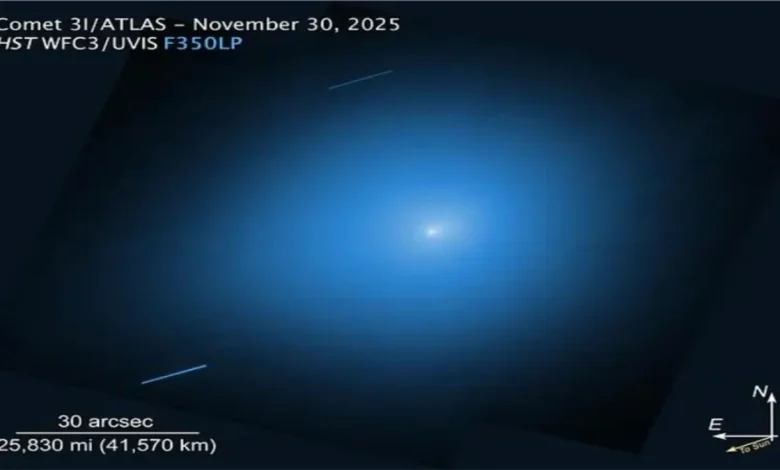
The Hubble Space Telescope has captured a fresh image of 3I/ATLAS, the third known interstellar object to enter our solar system. The photograph reveals a teardrop-shaped luminous halo stretching toward the Sun. Hubble made the observation on November 30 from 286 million kilometres away, approximately one month following the comet’s closest solar approach.
Harvard researcher Avi Loeb noted that this anti-tail feature was also detected in July, shortly after 3I/ATLAS was first identified. He explained that the glowing region now measures roughly 40,000 kilometres in radius, while the anti-tail extends outward to approximately 60,000 kilometres. Loeb has proposed an explanation for the sunward-facing glow displayed by 3I/ATLAS.
His theory suggests the teardrop-shaped coma consists of numerous macroscopic non-volatile objects formed through non-gravitational acceleration directed away from the Sun. Loeb stated he had previously predicted this swarm would reach about 60,000 kilometres from the Sun on this specific date, a forecast confirmed by the latest Hubble imagery.
Potential object release near Jupiter
Loeb previously suggested that 3I/ATLAS might release small objects when approaching Jupiter. The comet is anticipated to pass extremely close to the planet’s Hill sphere, which Loeb considers an ideal moment for deploying such objects that could become captured by Jupiter’s gravitational field. He has speculated that 3I/ATLAS may be something beyond a conventional comet, initially even proposing it could serve as a “mothership” for extraterrestrial exploration of our solar system.




The European Space Agency previously shared an image of 3I/ATLAS captured by the Juice spacecraft during its journey toward Jupiter. While Juice has transmitted only partial data, the image indicates the comet demonstrated heightened activity following its solar encounter.
Read More: Mysterious Interstellar Comet 3I/ATLAS Streaks Across Our Solar System
Characteristics and Earth approach
3I/ATLAS represents just the third confirmed visitor from interstellar space. Its hyperbolic path revealed its extrasolar origin. The object initially traveled at an extraordinary velocity of 60 kilometres per second, which shifted after passing Mars and reaching perihelion. Scientists estimate its age between 7 and 14 billion years. The comet will make its nearest approach to Earth on December 19, 2025. Currently visible in the night sky, amateur astronomers can observe it using binoculars or telescopes.