NASA’s Artemis II spacecraft is officially en route to the Moon after Orion’s main engine completed a translunar injection (TLI) burn lasting five minutes and 50 seconds, beginning at 7:49 pm EDT. The burn pushed the spacecraft out of Earth’s orbit and onto a lunar trajectory.
“Orion’s main engine provides up to 6,000 pounds of thrust, enough to accelerate a car from 0 to 60 mph in about 2.7 seconds,” NASA said.
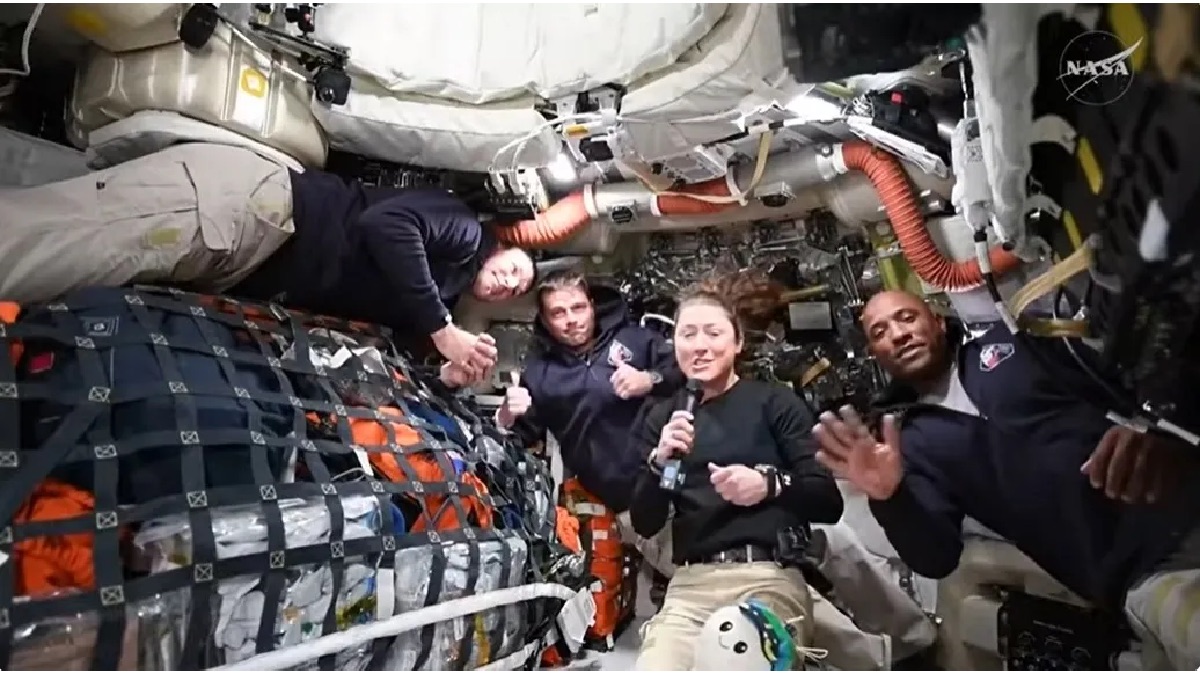
Aboard Orion are NASA astronauts Reid Wiseman, Victor Glover, and Christina Koch, along with Canadian Space Agency (CSA) astronaut Jeremy Hansen. In the mission’s first live stream from space, the crew described the TLI as a jarring experience. “The translunar injection was a pretty intense moment,” said Wiseman, the mission commander. Koch added that objects began floating around the cabin from the force of the burn.
During the stream, all four astronauts appeared in close quarters inside the capsule, discussing the launch, their workload, and sleep arrangements. Glover said the Day 1 launch itself came as a surprise, noting that engineers and the launch team had spent weeks preparing. Koch described the launch as gentler than anticipated. “One of the biggest surprises was how smooth the launch felt,” she said.
Also Read:NASA Engineers Fix Artemis II’s Broken Space Toilet Hours Before Moon Mission Launch
Wiseman reflected on the scale of what the crew had accomplished. “There is nothing normal about this setting for humans. We are 250,000 miles away, and that is a herculean effort. We are just now realising the gravity of it all,” he said.
How the Artemis II Crew Is Sleeping Inside Orion
The astronauts said they have been busy since launch, managing to share a meal together after several hours. Wiseman said the crew is still finding comfortable rest positions. Koch, he noted, has been sleeping upside down “like a bat” a position she described as comfortable and one she planned to keep unless someone displaced her.
What Earth Looks Like From 250,000 Miles Away
Here’s a view of Earth as seen by Artemis II 🌍 pic.twitter.com/YpIsG8kL7d
— NEXUSx (@Nexus_osintx) April 2, 2026
Viewing the full Earth through a single capsule window, the crew found the sight difficult to put into words. Glover addressed people back home directly: “We want to tell everyone that you look amazing. You look like one thing. We are all one people.” He added, “We’ve got to give ourselves a mission we can hold on to for the rest of our lives. This has happened when we have differences. Imagine what we can do when we put those differences aside and come together.” Orion is scheduled to reach the Moon on April 6, perform a lunar flyby, and use the Moon’s gravity to slingshot the crew back toward Earth.
-

-

-

-