
[By Devansh Desai Mumbai Samachar Desk]
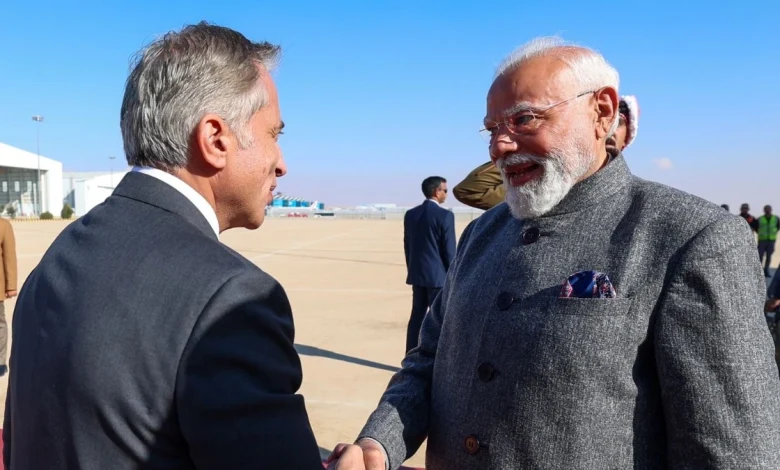
Prime Minister Narendra Modi arrived in Jordan on Monday evening, marking the first leg of a significant three-nation diplomatic tour that will also include Ethiopia and Oman. The Prime Minister is scheduled to spend two days in Jordan, a visit that carries immense weight as the two nations celebrate 75 years of diplomatic relations. Jordan holds a unique place in India’s diplomatic history, being among the first nations to establish formal ties with New Delhi post-independence.
While the first bilateral agreement for cooperation was inked in 1947, full diplomatic relations were formalized by 1950. Decades later, the commercial bond remains robust, with top leadership from both nations maintaining regular contact to assess and strengthen these ties.
A Geopolitical Anchor in a Volatile Region
Jordan acts as a vital geopolitical buffer, landlocked by five Arab nations: Saudi Arabia, Syria, Iraq, and the Palestinian territories. Its only maritime access is through the Gulf of Aqaba, which it shares with Egypt. Despite being a relatively small nation governed by the Hashemite Kingdom—with limited natural resources—Jordan plays an outsized role in the power dynamics of the Middle East and remains a key ally of the United States.



Historically, the region was carved out by Britain and France following the 1916 Arab Revolt against the Ottoman Empire during World War I. This led to the creation of the Emirate of Transjordan in 1921 under British protection, eventually gaining independence in 1946.
Jordan’s history with its neighbors is complex. It occupied the West Bank during the 1948 Arab-Israeli War but lost control to Israeli forces during the Six-Day War in 1967. By 1988, Jordan relinquished claims to the territory and, in 1994, became only the second Arab nation to sign a peace treaty with Israel.
The Refugee Challenge and Governance
The country faces significant demographic pressure. Jordan is home to approximately two million Palestinian refugees and, following the civil war in Syria, has absorbed nearly 1.4 million Syrian refugees. This influx has placed a severe strain on the nation’s infrastructure and resources.
King Abdullah II, who has ruled since 1999, wields extensive executive powers, including the ability to appoint governments, approve legislation, and dissolve parliament. While the King dismissed the government in 2011 to implement political reforms following the Arab Spring, the country continues to face sporadic protests related to the cost of living and economic challenges.
According to official government data, Jordan covers an area of 89,213 square kilometers with a population of over 9.5 million (2015 census). The terrain is largely arid, characterized by long, dry summers and brief winters.
Strengthening Economic Arteries
Despite global economic headwinds, trade between India and Jordan has expanded, with India emerging as Jordan’s fourth-largest trading partner. However, analysts suggest the relationship runs deeper than just balance sheets.
Ajay Srivastava, head of the Global Trade Research Initiative (GTRI) and former Additional Director General of Foreign Trade, notes that the “backbone” of this relationship is the human capital. Approximately 25,000 to 30,000 Indian nationals work in Jordan, primarily in manufacturing, construction, and services. These workers remit an estimated $250 to $350 million annually.
Srivastava points out that for a small, trade-dependent economy like Jordan (with a GDP just over $50 billion), these ties highlight how India’s supply chain integration extends well beyond its immediate neighborhood.
Trade and Economic Ties with India
The trade portfolio is highly specific and strategic. India exports food products such as rice, meat, tea, and coffee to Jordan. In return, India imports phosphoric acid and calcium phosphate—raw materials that are critical for India’s domestic fertilizer and chemical industries.
In the fiscal year 2023-24, bilateral trade stood at $2.875 billion, with Indian exports accounting for $1.465 billion and imports at $1.411 billion. This followed a peak in 2022-23, where total trade reached $4.434 billion. Collaboration in the fertilizer sector is particularly strong, highlighted by joint ventures between the Jordan Phosphate Mining Company (JPMC) and Indian giants like IFFCO.
Cultural Diplomacy and Soft Power
Beyond commerce, the two nations share a vibrant cultural connection. The 17,500-strong Indian diaspora in Jordan is active across various sectors, from textiles to IT and healthcare. Travel has been eased significantly, with Jordan offering visas on arrival to Indians since 2009, and India extending e-tourist visas to Jordanians since 2014.
Soft power remains a major conduit for friendship. Bollywood films are a staple in Jordanian households. The country has also become a filming destination for Indian cinema, hosting productions like the 2024 Bollywood action film Bade Miyan Chote Miyan and the Malayalam drama Aadujeevitham, which was shot during the height of the pandemic in 2020.
Recent cultural exchanges include the Amaiza Dance Troupe’s participation in the 39th Jerash Festival in July 2025. Furthermore, environmental and wellness initiatives have strengthened bonds, such as the ‘Ek Ped Maa Ke Naam’ tree-planting drive in Irbid in September 2025, and International Yoga Day celebrations held at the Royal Botanic Garden under the patronage of Princess Basma bint Ali.