Temple Politics Heats Up In Bengal: Will Mamata’s ‘Durga Aangan’ Counter BJP’s Hindutva Push Ahead of 2026 Polls?
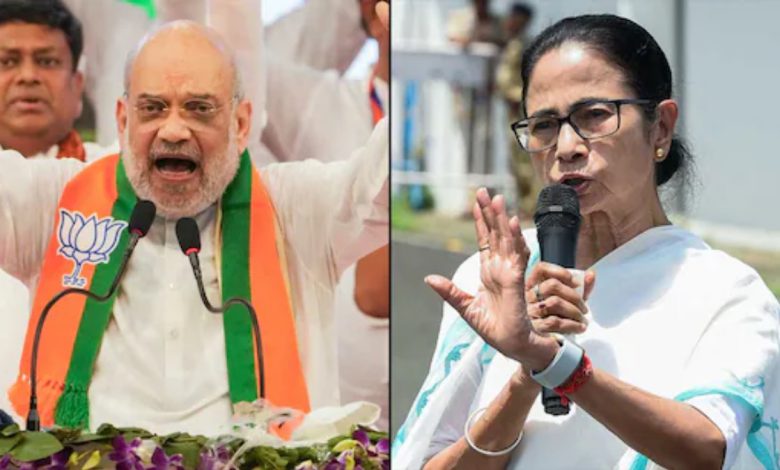
With West Bengal’s 2026 Assembly elections on the horizon, the battle over religious sites and cultural symbols has intensified between Chief Minister Mamata Banerjee’s Trinamool Congress (TMC) and the opposition Bharatiya Janata Party (BJP).
The state government’s announcement of multiple temple and cultural complex projects has deepened the political confrontation, with both parties accusing each other of vote-bank politics centered around religion.
On December 30, Chief Minister Mamata Banerjee laid the foundation stone for ‘Durga Aangan’—a cultural complex in Kolkata’s New Town area. The project is being linked to the UNESCO recognition of Durga Puja as an intangible cultural heritage.
According to state government sources, the complex will be built across 17 acres and house temples dedicated to Durga, Shiva, Ganesha, Kartik, Saraswati, and Lakshmi. The project carries an estimated cost of approximately ₹262 crore.
Speaking at the event, Mamata Banerjee said, “Durga Puja is not just a religious event; it is part of Bengal’s culture and heritage. It is our responsibility to preserve it.”
The BJP has dismissed the project as electoral appeasement. Party leaders allege that TMC is attempting to win over Hindu sentiments ahead of the polls. BJP IT cell chief Amit Malviya stated, “Mamata Banerjee’s ‘Durga Aangan’ project is steeped in appeasement politics, just like her governance. This is a mockery of Bengali Hindu faith, and devotion is being exploited for vote banks.”
Mamata Hits Back at Appeasement Charges
However, Mamata Banerjee has firmly rejected BJP’s allegations. She stated, “When someone comes for religious assistance—whether Hindu, Muslim, Jain, Christian, or Parsi—some people say I’m doing appeasement. I don’t do appeasement. I am truly secular.”
“You cannot show me a single religion whose programs I don’t attend. When I go to a gurudwara, I cover my head, and nobody objects. Then why is there objection when I attend Eid celebrations?”
The ‘Durga Aangan’ is part of Mamata Banerjee’s recent series of religious and cultural initiatives. Earlier, a replica of Jagannath Temple was constructed in Digha. According to the government, the foundation stone for Mahakal Temple in North Bengal will be laid in the second week of January.
Kolkata-based political expert Maidul Islam observes, “I think Mamata is now challenging BJP on its own turf. She herself is a Brahmin. Mamata understands voting behavior and patterns very well and manages various groups effectively.”
“For the past ten years, BJP has been continuously campaigning against her, branding her as an anti-Hindu leader. When BJP became the main opposition force in West Bengal, the entire picture changed. This wasn’t the case between 2011-2016. When leftist politics weakened in the state, this narrative was inevitable.”
Babri Masjid Shadow and Humayun Kabir Controversy
Amid temple politics, the Babri Masjid issue has also emerged in Bengal’s political landscape. BJP leaders allege that while TMC is trying to woo Hindu voters, messages are simultaneously being sent to the minority vote bank.
TMC-suspended MLA Humayun Kabir laid the foundation stone of a mosque in Murshidabad district on December 6. Subsequently, large numbers of people arrived with donations and construction materials. The party suspended Kabir following this incident.
During a pre-election tour of West Bengal, Home Minister Amit Shah remarked, “Who is doing ‘temple and mosque’ politics? One is a former TMC MLA and the other is TMC itself. Bengal’s people must decide how appropriate such actions are as elections approach.”
Mamata Banerjee has consistently rejected accusations of Muslim appeasement. On December 22, Humayun Kabir announced plans to form a new party, stating, “The Muslim community now wants its own representation.” He claimed, “Muslim votes cannot be taken lightly. If their voice is suppressed, political consequences will follow.”
Maidul Islam maintains that Mamata’s Hindutva differs from BJP’s version. He explained, “Since the 2019 Lok Sabha elections, Hindu voters have been voting for BJP. Among communities like SC, ST, and OBC, this has exceeded 60%. Since Muslims have no other option and their votes won’t go elsewhere, Mamata has calculated they will vote anyway, so we need to focus on Hindu votes. Her Hindutva is very different from BJP’s. It centers around Bengali deities like Jagannath, Mahakali, and Durga.”
Vote Bank and Identity Politics
BJP alleges that TMC has long practiced minority vote-bank politics and is now adopting Hindu cultural symbols under electoral pressure.
Professor Biswanath Chakraborty from Rabindra Bharati University stated, “West Bengal has gradually acquired Hindi Belt politics. It has shifted from issue-based politics to identity-based politics, where religion and caste are prominent.”
“TMC is trying to ensure Muslims vote for them, while BJP is mobilizing Hindu votes. They’re alleging Mamata is appeasing Muslims and discriminating against Hindus. Mamata is trying to break her anti-Hindu image, hence all these temple-related initiatives. This will be the main issue of the 2026 elections.”
BJP MP Jyotirmay Singh Mahato stated, “Both these projects belong to Mamata Banerjee herself—both the Babri Masjid and ‘Durga Aangan’. Ultimately, taking Ram’s name won’t benefit her. For 15 years, she has persecuted the Hindu population. Bengal’s people haven’t forgotten anything. In the 2026 elections, people will bid her farewell.”
In response to BJP’s accusations, TMC has raised issues of attacks on Bengali-speaking migrants and worker arrests in several states.
Rajya Sabha MP and TMC leader Samirul Islam said, “BJP claims it will keep Bengal peaceful and prosperous. Those who beat people just for being Bengali, who go to the extent of killing someone for speaking Bengali, are now talking about Bengal’s development! In BJP-ruled states, people face police persecution daily merely for speaking Bengali. BJP leaders openly insult Bengalis.”
Hindu Voters Tilting Toward BJP?
Identity politics plays a crucial role in West Bengal’s electoral arithmetic. In the 2019 Lok Sabha and 2021 Assembly elections, BJP performed well on Hindutva issues. Following Congress’s decline in 2014 and the Left’s fall in 2019, BJP emerged as the main opposition party in West Bengal.
In the 2019 Lok Sabha elections, BJP won 18 out of 42 seats in the state. This trend continued through the 2021 Assembly elections and last year’s parliamentary polls.
Biswanath Chakraborty noted, “In 2021, 87% of Muslims voted for TMC, while 54% of Hindus voted for BJP. This trend continued in the 2024 national elections. It’s established that Mamata is getting most Muslim votes while the majority Hindu vote is going to BJP.”
“However, BJP receiving over 50% of Hindu votes isn’t sufficient to remove the TMC government. Therefore, BJP is trying to secure Hindu votes through Hindutva politics—raising issues like attacks on Hindus in Bangladesh, illegal immigration, and Rohingyas.”