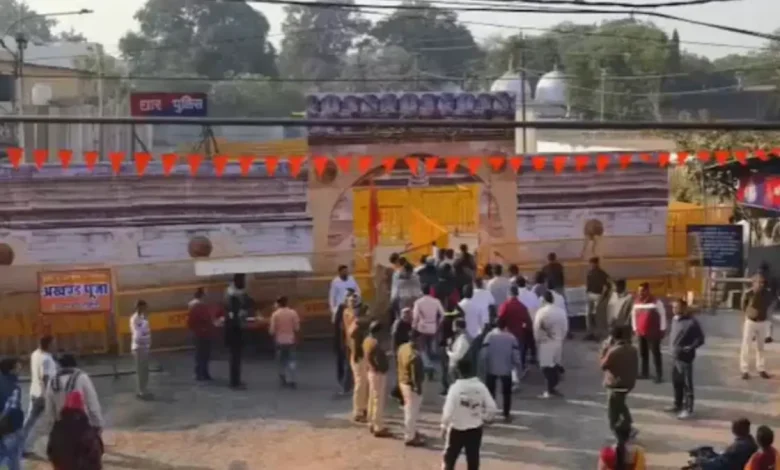
New Delhi : The Supreme Court on Thursday ruled that both Hindu and Muslim devotees may offer prayers at the disputed Bhojshala complex in Madhya Pradesh’s Dhar on Friday, January 23, as the Saraswati Puja festival coincides with customary Friday prayers.
A fair suggestion was given that in the afternoon for namaz within 1 and 3 pm and exclusive and separate area within the same compound including separate ingress and eggress within the same compound shall be made available so that Namaz can be performed. The Bhojshala complex, an 11th-century monument protected by the Archaeological Survey of India (ASI), has long been the subject of a religious dispute. Hindus consider it a temple dedicated to Goddess Saraswati, while Muslims claim it as the Kamal Maula Mosque.
The application was filed on January 2, 2026, by advocate Vishnu Shankar Jain on behalf of the HFJ and was mentioned urgently before the apex court on Tuesday. Acting on the request, the Supreme Court listed the matter for hearing on Thursday, January 22, a day ahead of Basant Panchami, which falls on Friday. Explaining the urgency, Jain submitted that the Archaeological Survey of India’s (ASI) April 7, 2003 order does not address situations where Basant Panchami coincides with Friday prayers.
He sought exclusive, uninterrupted worship rights for Hindus for the entire day on January 23.
The 2003 ASI order permits Muslims to offer Friday namaz at the site between 1 p.m. and 3 p.m., while allowing Hindus to perform traditional rituals on Basant Panchami and granting them exclusive access every Tuesday. According to records, such a calendar overlap occurred in 2006, 2013 and 2016. In those years, the ASI issued advance directions permitting namaz from 1 p.m. to 3 p.m. and allowing Hindu rituals from sunrise till noon and again from 3.30 p.m. to sunset, with restrictions on the quantity of flowers and rice carried for worship.


In the absence of a fresh ASI order, the Supreme Court hearing has assumed significance, particularly as the town of Dhar remains communally sensitive. Hindu and Muslim groups have maintained firm positions on access to the site. The HFJ has sought exclusive access for Hindus to perform the Goddess Saraswati puja throughout the day on Basant Panchami, along with strict security arrangements by the ASI and the state government. The Bhojshala complex, a protected monument under the ASI, is claimed by Hindus as an ancient temple dedicated to Goddess Vagdevi (Saraswati), believed to have been built by Parmar ruler Raja Bhoja in the 11th century.
The petition further alleges that allowing Friday namaz without a final determination of the monument’s religious character violates the spirit of the Ancient Monuments and Archaeological Sites and Remains (AMASR) Act. It argues that Basant Panchami holds special religious significance in Sanatan Dharma and that overlapping observances on rare occasions have previously led to tension and disorder.
Read Also : Karnataka Governor Walks Out Of Assembly After Refusing To Read Govt Speech, Know What CM Siddaramaiah Said