
ISRO’s Comeback Launch: Spy Satellite and Private Sector Milestone Signal India’s Space Ambitions
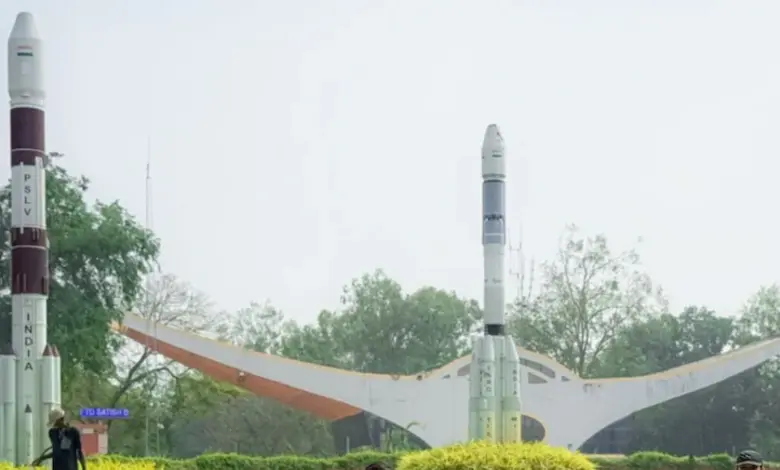
On January 12, the Polar Satellite Launch Vehicle (PSLV), widely regarded as ISRO’s reliable workhorse, is scheduled to lift off at 10:17 am from the Satish Dhawan Space Centre in Sriharikota. This will be the rocket’s 64th flight, designated PSLV-C62 / EOS-N1, and follows a setback in May 2025 when the previous PSLV mission encountered a third-stage anomaly.
The mission will deploy a total of 15 satellites. The primary payload includes the highly classified surveillance satellite Anvesha (also referred to as EOS-N1), developed by the Defence Research and Development Organisation (DRDO). Equipped with advanced imaging technology, Anvesha is designed to deliver high-precision reconnaissance capabilities, enabling accurate mapping of strategic targets and strengthening India’s defense surveillance from space. This hyperspectral Earth observation asset also supports applications in agriculture, urban planning, and environmental monitoring.
Adding to the mission’s importance is the prominent role of the private sector. For the first time, a single Indian private company—Hyderabad-based Dhruva Space—will contribute seven satellites. These include payloads such as Thibolt-3 for connectivity and remote monitoring, along with student-developed satellites in collaboration with institutions like Dayanand Sagar University (Karnataka), CV Raman Global University (Odisha), and Assam Don Bosco University. Dhruva Space is also providing deployers for the missions and offering ground station services for select satellites, including support for initiatives like AAYULSAT (from OrbitAID) and MOI-1 (from TM2 Space).
ALSO READ : ISRO Successfully Launches LVM3-M6 Rocket Carrying Bluebird Block-2 Satellite




The remaining co-passengers encompass eight additional satellites, featuring international contributions from countries such as France, Nepal, Brazil, and the UK, as well as the Kestrel Initial Technology Demonstrator (KID)—a prototype re-entry vehicle from a Spanish startup, which will test controlled atmospheric re-entry with a planned splashdown in the South Pacific Ocean.
In an exclusive statement to NDTV, ISRO Chairman Dr V Narayanan emphasized the mission’s dual significance: “India’s workhorse rocket will show what ISRO can do for user agencies. The main passenger protects India from the skies and the smaller co-passengers signify how India’s private space sector is flourishing with just one Hyderabad company Dhruva Space contributing to seven satellites, setting a new benchmark.” He added that the launch underscores the Department of Space’s contributions to national security, industry empowerment, and broader societal benefits.
Vishal Latha Balakumar, Director of Space Missions at Dhruva Space, expressed strong confidence in the PSLV despite the prior failure, noting the rocket’s proven reliability and the company’s extensive involvement, including building satellites, supplying deployers, and pioneering ground station-as-a-service under the first license issued by IN-SPACe.
Managed by NewSpace India Limited (NSIL), ISRO’s commercial arm, this represents the ninth dedicated commercial mission for the organization. The inclusion of diverse international payloads highlights India’s growing appeal as a trusted global launch partner, building on the PSLV’s legacy, including its 2017 record of deploying 104 satellites in a single flight.
This mission represents a pivotal moment for India’s space program—demonstrating resilience after recent challenges, reinforcing strategic capabilities through Anvesha, and accelerating the growth of a robust private ecosystem that promises end-to-end space solutions. A successful outcome could further solidify India’s position in the international space economy.