How Resizing Undergarment Led To Disqualification Of Kerala MLA
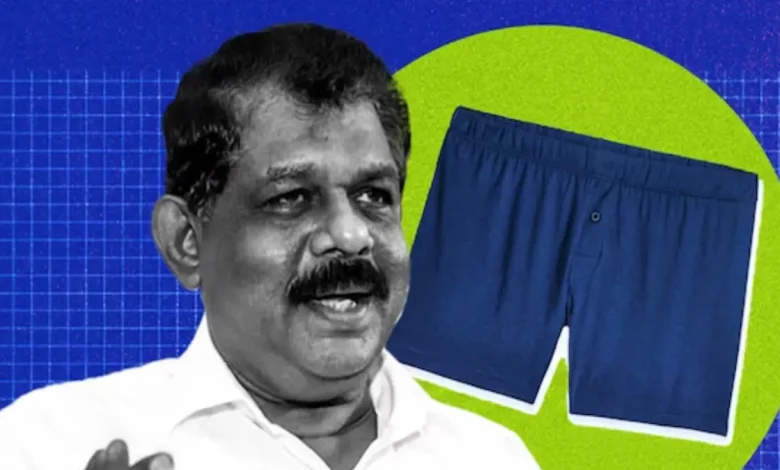
Thiruvananthapuram : On January 3, a court in Thiruvananthapuram delivered a historic verdict that brought to a close one of India’s most convoluted legal sagas, convicting Antony Raju, a sitting MLA and former Kerala minister, for tampering with evidence in a drug case. The three-year prison sentence automatically disqualified the ruling Left Democratic Front (LDF) legislator from the Assembly, effectively ending his political career, especially with state elections slated to be held this year.
The MLA was found guilty of orchestrating the deliberate tampering of this key piece of evidence to secure the acquittal of the foreign national, who had earlier been convicted of smuggling. The case dates back to 1990, when Australian national Andrew Salvatore Cervelli was arrested at Thiruvananthapuram International Airport with 61.5 grams of hashish concealed in a secret pocket stitched into his dark blue underwear.
Raju, then a young and ambitious lawyer, was involved in the case as a junior advocate assisting the counsel who represented Cervelli in the Sessions Court. The prosecution’s case appeared strong: the contraband had been recovered directly from the accused and was properly documented and preserved. In 1992, the Sessions Court convicted Cervelli, sentencing him to 10 years of rigorous imprisonment and imposing a fine of Rs 1 lakh.
However, what should have been the conclusion of a routine narcotics prosecution soon turned into an elaborate scheme to manipulate judicial evidence. It consumed decades, involved international law enforcement agencies, witnessed acquittals and case restorations, and ultimately the conviction of Raju. The pivotal moment came in early 1991 when Cervelli’s legal team appealed to the Kerala High Court, focusing squarely on the physical evidence.




The defence argued that the underwear seized and kept in police custody did not belong to the Australian national. During the appeal hearings, the defence sought an extraordinary demonstration wherein Cervelli would attempt to wear the underwear in open court to prove it was not his. This moment became the linchpin of the entire case. When Cervelli tried to wear the undergarment, it did not fit. The underwear appeared noticeably smaller, raising serious doubts over the prosecution’s contention that Cervelli was wearing that underwear at the time of his arrest.
Finding the argument persuasive, the High Court acquitted Cervelli in February 1991, holding that the prosecution had failed to prove that he was wearing the seized underwear at the time of arrest. However, the judgment carried a telling observation: that there was a strong possibility the evidence had been planted to help the defendant escape liability. I hope that this matter will be duly enquired into and dealt with properly by the concerned authorities, the judge noted. The acquittal sent Cervelli back to Australia a free man.
Later Cervelli was remanded to prison in Australia in connection with a murder case. While in jail, he reportedly confessed to his co-accused, Wesley John Paul, that his Kerala drug case had been manipulated. According to reports, Cervelli disclosed that his family had travelled to India and paid a bribe to swap the original underwear with a smaller one. Paul passed this information on to Australian police, triggering a chain of international communication. Australian authorities alerted Interpol, which forwarded the intelligence through the Australian National Central Bureau to Indian agencies.
The revelation confirmed what KK Jayamohan, the original investigating officer in the 1990 drug seizure case, had long suspected. Jayamohan had personally seized the underwear from Cervelli and knew that it fit him at the time of arrest. The subsequent investigation meticulously reconstructed the chain of custody of the critical evidence. What emerged was a stunning breach of court protocol and manipulation. Under standard procedure, only items explicitly listed in a release order may be handed over after a conviction.
Read Also : Supreme Court Questions Stray Dog Lovers: “Don’t Chickens, Goats Have Lives Too?”