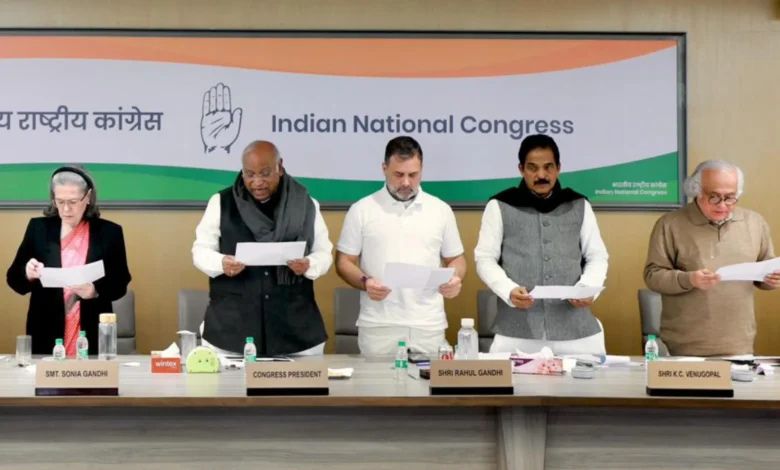
The Indian National Congress (INC) will launch the ‘MGNREGA Bachao’ movement starting January 5, party president Mallikarjun Kharge announced on Saturday. He emphasized that Congress will oppose the Viksit Bharat Guarantee for Rozgar and Ajeevika Mission (Gramin) (VB-G RAM G) Act through street protests and parliamentary resistance.
Speaking at the Congress Working Committee (CWC) meeting, Kharge stated that the Mahatma Gandhi National Rural Employment Guarantee Act (MGNREGA) represents more than a government program it embodies a constitutional right to employment. “People are angry over repeal of MGNREGA, govt will have to face the consequences,” PTI quoted Kharge as saying.
“This law has been brought to crush the poor; we will fight against it on the streets and in Parliament,” he added. The Congress President drew parallels to the opposition’s stance during the 2020-21 farmers’ protests against three controversial agricultural laws.
Kharge recalled, “In June 2020, amidst the lockdown, Modi ji brought in an Ordinance and imposed the three black farm laws. Despite opposition from the Opposition in Parliament, the laws were passed. Over 700 farmers who were protesting against it attained martyrdom. The government laid nails, sprayed water cannons, and suppressed them.”



He noted that Congress had stood firmly with the protesting farmers, ultimately forcing the Prime Minister to apologize and withdraw the legislation in November 2021. Kharge highlighted that Lok Sabha Leader of Opposition Rahul Gandhi had predicted the repeal of these “black laws” and recently forecasted that the Modi government would be compelled to restore MGNREGA.
Gandhi accuses PM of unilateral destruction of MGNREGA
Rahul Gandhi declared that the party would vigorously challenge the VB-G RAM G Act, expressing confidence in unified opposition resistance. He characterized the legislation as a devastating attack on states and impoverished citizens, alleging that Prime Minister Narendra Modi pushed it through without consultation, much like demonetisation.
“PM single handedly destroyed MGNREGA without asking his Cabinet, without studying the matter,” Gandhi claimed. He argued that MGNREGA transcended mere employment provision, functioning as a globally recognized development framework. Gandhi asserted that repealing MGNREGA undermines both the rights-based governance approach and India’s federal structure.
Understanding the new legislation
The VB-G RAM G Act, which supersedes the two-decade-old UPA-era rural employment guarantee scheme, received parliamentary approval on December 18 during the recently concluded Winter Session and obtained Presidential assent on December 21 despite strong opposition protests. The legislation guarantees rural workers 125 days of wage employment annually.
Under Section 22, funding responsibilities between the Central and State Governments follow a 60:40 split. For North Eastern States, Himalayan States, and certain Union Territories (Uttarakhand, Himachal Pradesh, and Jammu and Kashmir), this ratio adjusts to 90:10.
Read More: Congress Working Committee Meets To Rework Strategy After Bihar Setback
Section 6 authorizes state governments to designate a combined 60-day period within each financial year to accommodate peak agricultural activities during sowing and harvesting seasons.
(With inputs from PTI)