Operation Sindoor Ongoing, Any Misadventure Will Be Dealt With Firmly: Army Chief
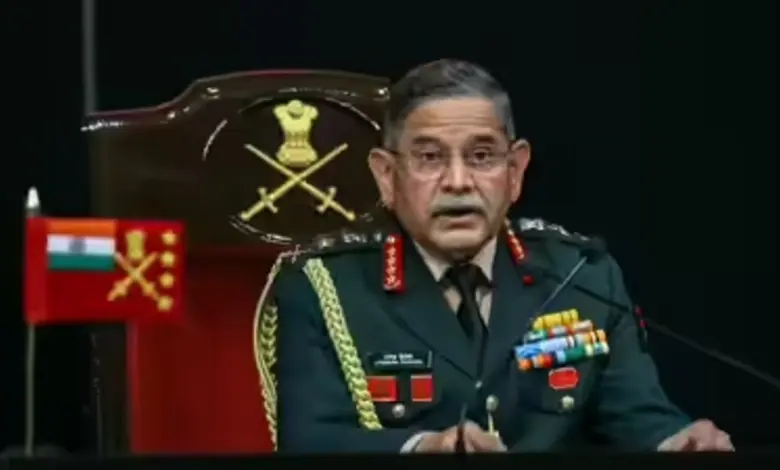
New Delhi: Indian Army Chief General Upendra Dwivedi disclosed on Tuesday that Pakistan urgently sought to halt hostilities during last year’s brief conflict with India after observing large-scale movements by the Indian Army, Air Force, and Navy. These manoeuvres, ordered on the morning of May 10 in preparation for potential escalation under Operation Sindoor, served as the critical trigger prompting Islamabad to contact India’s Director General of Military Operations (DGMO) to suspend the confrontation.
The three-day operation stemmed from India’s retaliatory strikes on May 7 against terrorist infrastructure in Pakistan and Pakistan-occupied Kashmir (PoK), following a deadly jihadi attack in Pahalgam, Jammu and Kashmir, in April. General Dwivedi highlighted two pivotal moments that shifted the dynamics. The initial 22-minute precision strike on terror targets disrupted the adversary’s planning, causing confusion and leading to poorly coordinated responses that India countered measuredly.
The second decisive factor occurred when Pakistan, through satellite surveillance, tracked Indian tri-service deployments—including ships, aircraft, and ground units—positioning for possible wider conflict. Recognizing the implications, Pakistani authorities concluded the fighting must end, the Army chief stated. He emphasized that Operation Sindoor exemplified exceptional synergy among the armed forces, guided by explicit political directives and operational autonomy.
ALSO READ : India Was Fully Prepared For Ground Action During Op Sindoor Says Army Chief General Upendra Dwivedi

During the clashes, the Indian Army destroyed seven of nine targeted sites and contributed significantly to calibrated retaliation. Approximately 100 individuals linked to Pakistan were killed in exchanges along the Line of Control (LoC) and International Border (IB).
Addressing nuclear rhetoric from Pakistani political figures during the four-day period (May 7-10), General Dwivedi clarified that no nuclear matters were raised in DGMO-level discussions. He attributed such statements solely to politicians and public discourse, with no evidence of similar positions from Pakistan’s military.
On the persisting threat, the Army chief reported that eight terrorist camps remain operational on the Pakistani side—six along the LoC and two along the IB—with an estimated 100-150 terrorists present. Indian forces maintain vigilant monitoring and stand prepared to respond firmly to any hostile activity.
The chief also noted recent detections of suspected Pakistani drones along the LoC and IB on January 10 and 11, prompting India to convey a strong warning to Islamabad that such incursions are unacceptable.
In Jammu and Kashmir, General Dwivedi pointed to substantial progress, with 65% of terrorists neutralized in 2025 being Pakistani nationals. Under Operation Mahadev, security forces eliminated 31 terrorists last year, including three involved in the Pahalgam attack. Local terrorist numbers have dropped to single digits, and recruitment has nearly ceased, with only two cases recorded in 2025. He cited revived tourism, a successful Amarnath Yatra attracting over 400,000 pilgrims, and ongoing development as signs of positive transformation in the region.