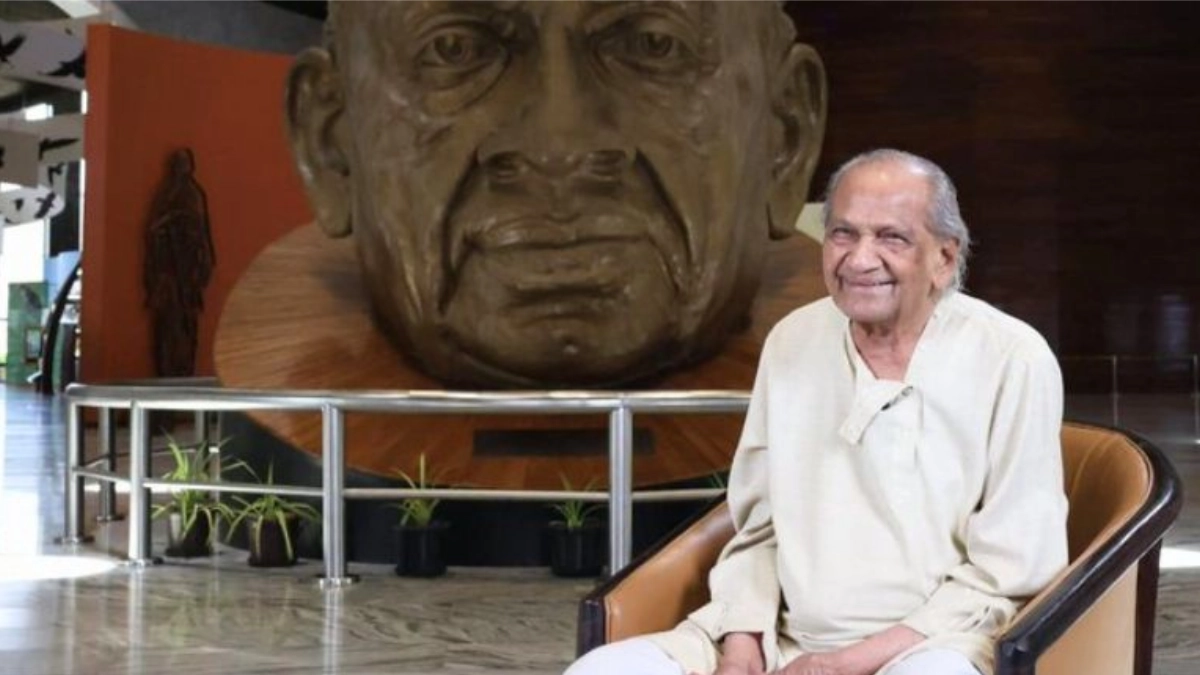
Paraphrased Article: Renowned Indian sculptor Ram Sutar, celebrated for designing the Statue of Unity in Gujarat the world’s tallest statue died late Wednesday night at his home in Noida. He was 100 and had been suffering from age-related health issues. His death is being seen as a major loss to India’s tradition of monumental public sculpture, with his works having shaped the look of many modern memorials.
Confirming the passing, his son Anil Sutar said on Thursday, “It is with profound grief that we inform you of the passing of my father, Shri Ram Vanji Sutar, on December 17 at midnight at our residence.”
Ram Sutar’s life and work
Born on February 19, 1925, in Gondur village in Maharashtra’s Dhule district, Sutar showed an early interest in art and sculpture. He later studied at Mumbai’s JJ School of Art and Architecture, where he graduated as a gold medallist. Over a career spanning more than seven decades, he went on to become one of India’s most influential sculptors.
His notable works include a seated, meditative statue of Mahatma Gandhi, an equestrian statue of Chhatrapati Shivaji Maharaj at the Parliament complex, and multiple statues of Dr B R Ambedkar, Jyotiba Phule, Savitribai Phule and other national icons. His most globally recognised creation remains the 182-metre Statue of Unity, dedicated to Sardar Vallabhbhai Patel India’s first Deputy Prime Minister and Home Minister which stands as the tallest statue in the world.
Awards and final projects
Sutar received the Padma Shri in 1999 and the Padma Bhushan in 2016 for his contribution to art and heritage. Earlier this year, he was honoured with the Maharashtra Bhushan Puraskar, the state’s highest civilian award, for his lifelong work in sculpture and public art.
Even in his final years, he remained active professionally. At 100, he was still associated with work on the Dr Babasaheb Ambedkar memorial at Indu Mill in Mumbai.
Condolences from Maharashtra leaders
Leaders across parties paid tribute to Sutar after his death. Maharashtra Chief Minister Devendra Fadnavis remembered him as a globally recognised artist who “breathed life into stone” and recalled visiting Sutar’s Noida residence recently to present the Maharashtra Bhushan honour.
Deputy Chief Minister Ajit Pawar said Sutar’s passing marked the end of a “golden era” in Indian sculpture, and praised his humility, commitment and efforts to guide younger sculptors. Chief Minister Eknath Shinde described him as the “Kohinoor of sculpture,” saying his monumental creations would keep his legacy alive for generations.