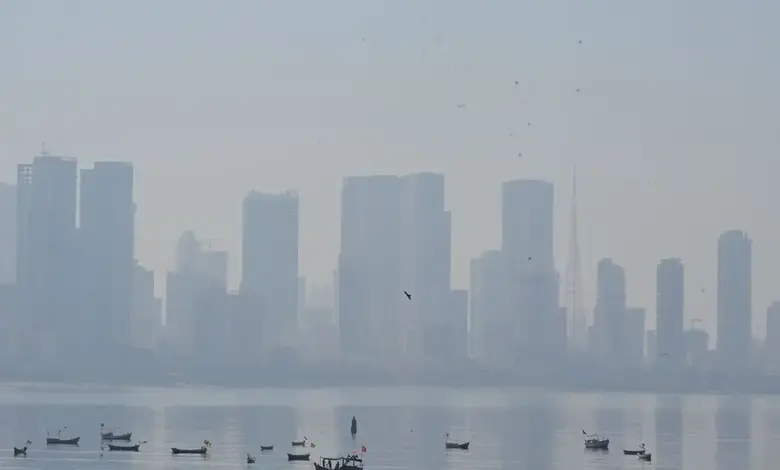
Mumbai – Unexpected rainfall on New Year’s Day has helped improve air quality in Mumbai, dropping the city’s overall air quality index (AQI) to a satisfactory 63 on Friday.
According to data, this level poses minimal health risks for most residents, although those with sensitivities may face minor respiratory discomfort.
The India Meteorological Department (IMD) forecasts a partly cloudy morning with haze across Mumbai and its suburbs, giving way to mostly clear skies later in the day. Temperatures are expected to reach a high of around 30 degrees Celsius and a low of about 17 degrees Celsius.
Current AQI readings at various monitoring stations include Bandra-Kurla Complex at 89, Borivali at 64, Byculla at 78, Andheri at 68, Chembur at 49, Deonar at 78, and Ghatkopar at 37.
In 2025, Mumbai enjoyed satisfactory air quality for nearly 40 percent of the year. January recorded moderate air quality on all 31 days, while months like December (29 days), February (26 days), and November (24 days) also saw high numbers of satisfactory days. The city experienced only one poor air quality day on October 11, when the AQI reached 211 due to elevated ozone levels.
Monsoon months from May to September registered entirely satisfactory conditions. In December, two days qualified as moderate but closer to satisfactory: December 21 with an AQI of 91 and December 24 at 86.
Environmentalist Sumaira Abdulali, founder of the Awaz Foundation—which collaborates with the BMC on pollution awareness—warned that underlying issues persist. “PM2.5 levels in the air continue to be high,” she noted. “This is a major concern as PM2.5 poses severe health risks. The particles are so small that humans can inhale them, and they accumulate in the lungs, causing severe health problems. While the overall AQI may be low, high levels of PM2.5 concentrations in the air pose a severe problem.”
ALSO READ : UTS App Stops Monthly Pass Bookings For Mumbai Local; Railway Passengers Directed To RailOne
Residents experienced light, unseasonal showers between 6:30 am and 8:00 am on Thursday. Certified meteorologist Rushikesh Agre, based in the city and trained at Harvard University, attributed the rain to weak western disturbances from the Mediterranean Sea shifting southward.
India’s AQI calculation incorporates eight key pollutants: PM10, PM2.5, carbon monoxide (CO), ozone (O3), nitrogen dioxide (NO2), sulfur dioxide (SO2), ammonia (NH3), and lead (Pb), requiring data from at least three, including either PM10 or PM2.5.
A study by the Centre for Research on Energy and Clean Air (CREA) revealed that in 2025, PM2.5 levels exceeded Mumbai’s annual average of 34 µg/m³ at every station for at least 35 percent of the year. Deonar emerged as the most affected area, followed by Worli and Bandra Kurla Complex, while Kandivali East logged the highest number of days surpassing daily PM2.5 standards.
-

-

-

-