
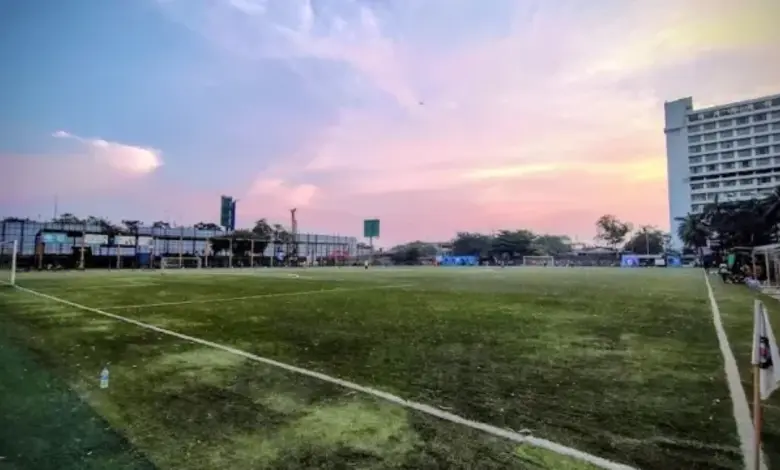
Bandra, Mumbai: Will the Brihanmumbai Municipal Corporation (BMC) genuinely dismantle one of the nation’s rarest FIFA-certified football grounds for a commercial venture? This heavy question looms over Mumbai as authorities push forward with a controversial plan to alter the land reservation of the iconic Neville D’Souza Football Ground at Bandra Reclamation.
Developed by the Mumbai Metropolitan Region Development Authority (MMRDA) in 2018, this 8,450-square-meter facility features top-tier FIFA-standard artificial turf. It serves as a lifeline for Mumbai Football Association league games, grassroots youth programs, and community tournaments, hosting hundreds of players and local clubs daily. Yet, civic committees have cleared a proposal to replace its playground tag with a reservation for an exhibition and convention centre, acting on a request from MHADA tied back to a 1983 layout.
ALSO READ: Footballer Dies After Lightning Strike During Match; Horrifying Incident Caught on Camera | VIDEO
Opposition leaders have slammed the move during BMC Standing Committee meetings, pointing out that the change is legally and technically untenable. Under Development Control and Promotion Regulations (DCPR) 2034 guidelines, an existing reservation can only be swapped if an equivalent alternate sports plot is provided simultaneously, a condition completely unmet here. Critics also question the public necessity of a convention center when a major facility already exists less than two kilometers away at the Bandra-Kurla Complex, not to mention the chaotic traffic it would unleash on local roads.



With an online petition crossing 10,500 signatures and mounting public outcry from athletes and residents, a hard reality sets in. As the file heads to the general body for final clearance, citizens are left wondering if city planners are willing to sacrifice prime sports infrastructure and the dreams of thousands of young footballers for concrete commercial complexes. This anxiety is deeply rooted in Mumbai’s urban history, where public amenities have frequently fallen victim to bureaucratic loops. Past precedents show how spaces like the prime 2.5-acre plot in Jogeshwari (East), acquired by the BMC in the 1980s explicitly for a public playground, were later engulfed by commercial towers and high-rise developments under the guise of slum redevelopment schemes. Yet, civic bodies have also faced massive pushbacks that forced narrow escapes, such as aggressive proposals to convert green pockets and garden-reserved plots in elite zones like Malabar Hill into residential spaces, which committees had to defer or send back under severe public scrutiny. Whether this football lifeline will share the tragic fate of lost grounds or survive the chopping block remains the ultimate test for the city’s remaining open spaces.