
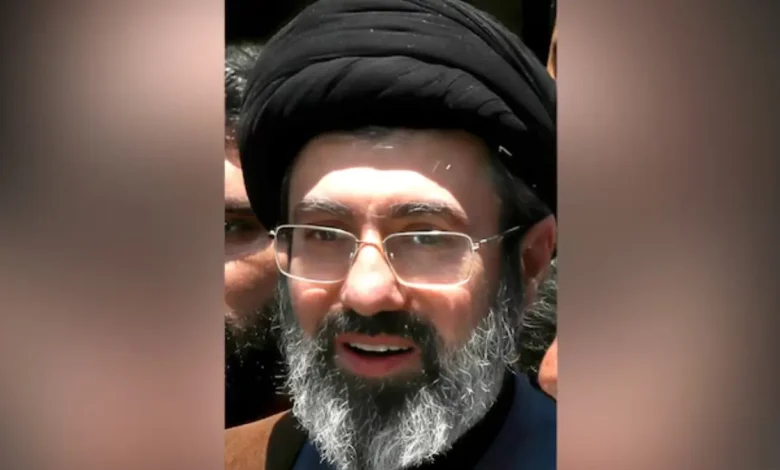
Tehran : Mojtaba Khamenei, the son of Iran’s Supreme Leader Ali Khamenei, has been chosen by the country’s powerful Assembly of Experts to assume the top post following his father’s death in a US–Israel strike in Tehran. Born in 1969 in Mashhad, Mojtaba Khamenei — the second son of Ali Khamenei — grew up during the final years of Shah Mohammad Reza Pahlavi’s rule.
His father, a fierce critic of the monarchy, joined forces with Ruhollah Khomeini, Iran’s first Supreme Leader, in the 1979 revolution that toppled the shah and established the country’s clerical republic, elevating the Khamenei family to the core of the new power structure. When Ali Khamenei became Supreme Leader in 1989, Mojtaba was brought up at the heart of Iran’s religious-political establishment, shaped by the institutions and networks that drove the Islamic Republic’s governance.
He remained largely out of the spotlight, rarely giving interviews and avoiding formal political office. Mojtaba’s ascent comes amid profound personal tragedy. On February 28, a US–Israeli airstrike targeted his father’s compound in Tehran, killing Ali Khamenei and several senior officials. Iranian authorities said the strike also claimed the lives of Mojtaba’s wife Zahra Adel, his mother Mansoureh Khojasteh Bagherzadeh, and one of his sons.
He served in the Habib Battalion, forging ties with individuals who later rose through Iran’s security and intelligence establishment. Those early connections would shape his reputation for decades. Support from the Revolutionary Guards is said to have been crucial to his selection, particularly at a time when Iran faces sustained military pressure and regional instability. To many observers, Mojtaba Khamenei represents continuity of a security-centric approach to governance.
After completing his military service, Mojtaba Khamenei pursued religious studies in Qom, Iran’s leading center of Shiite scholarship. He studied under senior clerics and later taught in seminaries, building theological credentials considered essential for the position of Supreme Leader.
In 2019, the US sanctioned him, alleging that Ali Khamenei had delegated aspects of authority to his son in an unofficial capacity — accusations Tehran denied. Mojtaba Khamenei’s name surfaced prominently during Iran’s disputed elections. After conservative candidate Mahmoud Ahmadinejad won the presidency in 2005, reformists accused Mojtaba of collaborating with clerical networks and the Revolutionary Guards to shape the outcome.
The Assembly of Experts — an 88-member clerical body constitutionally tasked with appointing and supervising the Supreme Leader — convened on Tuesday even as the US and Israel bombarded Iran with drones and missiles. Earlier, Ayatollah Khamenei had previously indicated that Mojtaba should not automatically be considered for succession. However, after his father’s death, Mojtaba ultimately emerged as the clear frontrunner.
Mojtaba Khamenei’s selection revives debate over dynastic overtones in a system born from a revolution that abolished hereditary rule. Vali Nasr, an Iran expert at Johns Hopkins University, has suggested that Mojtaba’s appointment would signal consolidation by hard-line factions aligned with the Revolutionary Guards. Others believe it demonstrates that the security establishment remains firmly in control, The New York Times reported.
Tehran-based analyst Mehdi Rahmati described Mojtaba Khamenei as a pragmatic choice for the current moment. “Mojtaba is the wisest pick right now because he is intimately familiar with running and coordinating security and military apparatuses,” Rahmati said, adding that he had effectively been overseeing much of that machinery already, The New York Times reported.
Read Also : Dubai Remains Calm, Safe Amid Iran-Israel Tensions: Mumbai Samachar